
Replacing fascias and soffits is more than swapping boards. The job runs in a set order, and each stage protects the roof edge and the roof space behind it.
People often expect a quick board swap, but a proper fascia and soffit replacement works through several stages. Whether your house in Warmley is a Victorian terrace, an older village property or a later estate home, the stages are the same, and they decide how well the finished eaves performs.
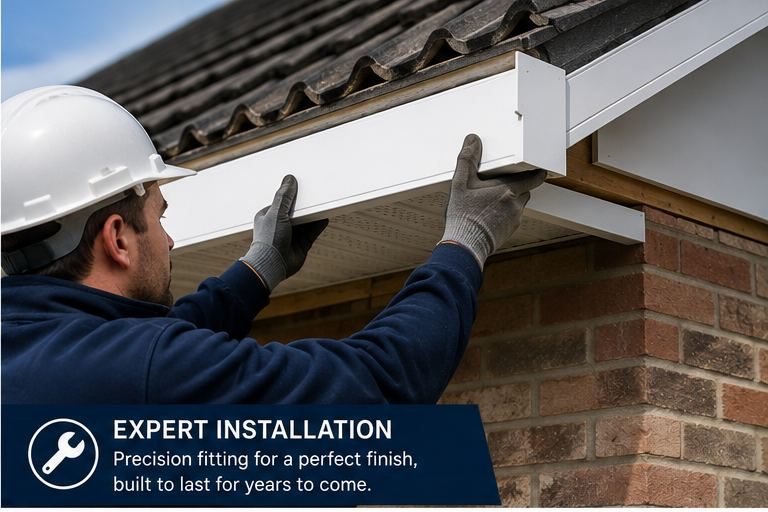
Access comes first
The work happens at the roof edge, so safe access is arranged before anything else, usually with scaffold or a suitable tower. This lets us work properly rather than leaning from a ladder. Access also lets us see the eaves clearly, which matters because the condition of the timber behind the boards is not visible from below.
On a house with an extension or a lower porch roof, access may need to be set up more than once to reach every section of roof edge. We plan this at the start so the work goes in a sensible order and you are not left with scaffold standing longer than it needs to.
Taking off the old boards and gutters
The gutters come off first, then the old fascias and soffits. Doing it in this order lets us look at what has been hiding behind them. We check the ends of the rafters, the wall plate and any sign of damp or insects, and deal with any soft timber before anything new is fixed.
- Gutters removed and set aside for refitting or replacing
- Old fascia and soffit boards taken off carefully
- Rafter ends and eaves timbers checked for damp or rot
- Any damaged timber repaired before new boards go on
Fitting new boards and ventilation
New UPVC fascias are fixed to the rafter ends, with soffits closing the underside of the eaves. We use vented soffits or vent strips so the roof space breathes and condensation does not build up. On older homes we check what the existing soffit boards are made of before disturbing them, and plan accordingly.
Where the roof space has felt a little damp or musty, the new ventilation can make a noticeable difference. Fresh air moving through the eaves helps timbers dry and cuts down condensation in the loft over time, which is part of why the eaves are worth doing properly.
Gutters and finishing
Once the boards are up, gutters are refitted or replaced and set to a proper fall towards the downpipes. Joints are sealed, corners are neat and the finish is checked from the ground. White is the usual choice, with darker and wood-effect finishes available to suit the house.
Tidying up and what you will notice
The site is cleared at the end of each day, and old boards are taken away. You should see a straight, clean roof edge and gutters that drain properly. Some work may need planning or Building Regulations checks, and we advise before work starts, so ask us early.
Frequently Asked Questions
How long will the work take?
It depends on the size of the house, the amount of scaffold needed and what we find behind the old boards. A simple roof edge goes quickly, while a larger house with rot to repair takes longer. We explain the likely scope before we start.
Will you disturb anything inside the house?
Very little. Work happens outside at the eaves. We may need to look into the loft from inside to check ventilation and rafter ends, but we keep any indoor disturbance small and tell you beforehand.
What happens if you find rot behind the boards?
We show you what we have found and repair or replace the affected timber before fitting anything new. Covering rotten wood with new boards just hides the problem, so we deal with it first and explain what was needed.
Talk to our team about UPVC fascias and soffits in Warmley
Every roof is different — the fastest way to get an accurate answer is a quick chat with our team.