
A garage flat roof replacement is a short, tidy job when it is planned well. This guide walks through the stages, from the old covering coming off to the new finish and its details.
Many of the garages behind Greenbank's terraces and inter-war houses have a flat roof that has been patched more than once. When patching stops working, a full replacement is the sensible step. It is a straightforward job in sequence, and knowing the stages helps you ask the right questions beforehand.
Looking before we strip
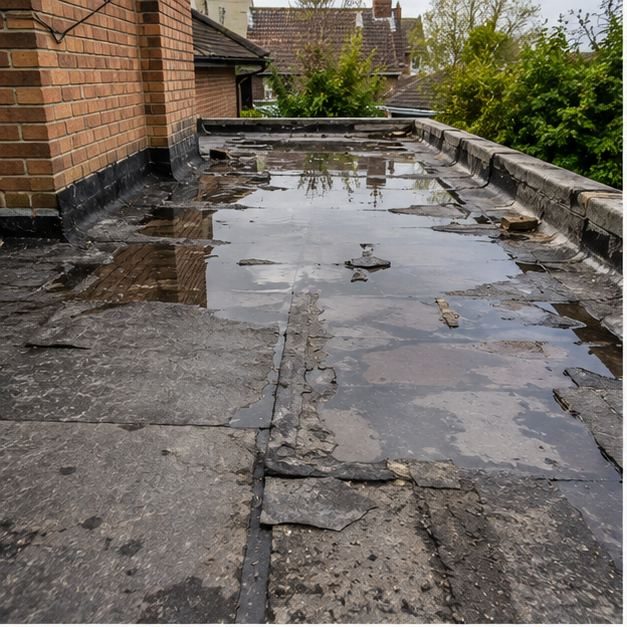
We start by judging whether the roof really needs replacing or only a repair. We check for ponding, splits, lifting edges, blocked outlets and soft spots underfoot from inside, if there is a ceiling or open rafters. Moisture inside the garage often tells the story. If most of the covering has failed, replacement is the honest answer. If only one area is bad, we say so. Photos of the inside of the garage ceiling, taken in daylight, help us plan the job before we arrive.
Stripping and checking the deck
The old covering comes off down to the boards. This is the moment we see what is really under it. Damp deck boards that have gone soft or rotten are cut out and replaced, as laying a new covering on poor timber just hides the problem. We also check the joists, the junction with the house or neighbouring wall and any rainwater outlet.
Falls, insulation and edges
Water has to run off, so we check the slope towards the gutter. A deck that is flat or dipped will hold water, so we correct it with firrings or new boards where needed. Insulation is added if the garage is used as a workshop or has a heated space. Edge trims and drip details are fitted so that water clears the wall and the gutter. On a garage backing onto a neighbour, we also look at how water is carried away at that boundary.
- Deck boards renewed where soft, damp or rotten.
- Falls corrected so water drains fully.
- New edge trims and a drip over the gutter.
- Upstands formed where the roof meets a wall.
Choosing the covering
Garage roofs are usually covered in single-ply rubber, fibreglass or a felt system. Each suits a different roof shape, budget and finish. A simple rectangle with few details suits rubber well, while a roof with awkward corners often suits fibreglass. We explain the options plainly and recommend what suits your roof, not the one that is easiest to fit.
The finish and what to ask
A good job ends with clean upstands, sealed corners and the outlet clear and working. Waste goes with us, and the site is left tidy. Planning or Building Regulations checks may be needed in some cases and we advise before work starts. Ask for a written description of the work, how old boards are dealt with and who will be on site.
Frequently Asked Questions
Will the garage need to be emptied?
Usually not, though it helps to move anything stored against the walls or under a leaking area. Most of the work happens on top. If the deck is rotten we may need to see the ceiling or rafters from inside.
Can a new covering go over the old one?
Sometimes, if the existing roof is dry and sound. Often it is not, and a covering laid over damp or failed material traps the problem. We check on site and tell you which route is sensible.
Do you replace the gutter too?
If the gutter is cracked, sagging or falling the wrong way, we recommend replacing it as part of the job, since a new roof needs a working edge to drain into. We tell you what we see and agree it with you.
Talk to our team about flat roofing in Greenbank
Every roof is different — the fastest way to get an accurate answer is a quick chat with our team.