
A roof space has to breathe. Vented soffits let fresh air in at the eaves so moisture can leave, and that matters in older Greenbank houses where lofts have been insulated and sealed over the years.
Most people see a soffit as the plain board under the gutter and nothing more. In fact it can be the roof's main air intake. In Greenbank's Victorian and Edwardian terraces, and the inter-war houses nearby, lofts have often been insulated since they were built, which makes good airflow more important, not less.
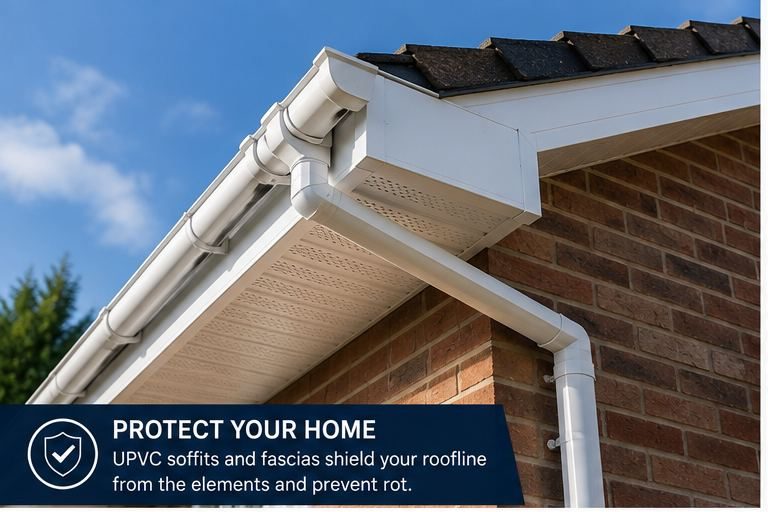
What the soffit actually does
The soffit closes the underside of the eaves, where the rafters stick out past the wall. Without it, birds, insects and weather would get straight into the roof. A vented soffit has small openings or a strip along it, so the board closes the gap but still allows a steady trickle of air to pass through into the loft.
Where moisture in a loft comes from
Everyday living puts moisture into the air: cooking, washing, drying clothes, breathing. Some of it drifts up through the ceiling into the roof space. If it has nowhere to go it settles as condensation on cold timber and felt, and you may see dark patches, damp insulation or a musty smell that is easily mistaken for a roof leak.
How the airflow works
Air enters at the eaves, rises along the underside of the roof and leaves at the ridge or through vents higher up. The movement carries moisture out with it. In a bay-fronted terrace with a long, steady roof slope, this flow can work well, provided nothing is blocking it at the bottom.
- Cool air in at the soffit, moist air out at the top.
- Insulation pushed hard into the eaves can choke the gap.
- Painted-over or blocked old boards give no air at all.
- A vent strip or disc soffit restores the intake.
What we do when replacing boards
When we replace fascias and soffits we take off the old boards and gutters, check the rafter ends and the eaves for rot, then fit new boards. We use vented soffits or vent strips so the roof space breathes. Where loft insulation reaches the eaves we make sure the air path stays clear. On older homes we check what the existing soffit boards are made of before disturbing them.
Signs your soffits may not be venting
From the ground you can look for boards that are solid and unbroken all the way along with no visible openings. From inside the loft, look for damp insulation, water droplets on the underside of the covering, or black spotting on timber. None of this needs you on the roof. If you see it, call us for a proper look and we will check the eaves from a safe position.
- Water droplets or damp on the underside of the roof.
- Dark spotting on rafters or the felt.
- A stale, musty smell in the loft.
- Mould around the edges of upstairs ceilings.
Frequently Asked Questions
Will vented soffits let in birds or insects?
No. The openings are small and sit behind a fine mesh or narrow slot, so air passes through but wasps, birds and larger insects do not. Fitted properly, a vented board keeps the eaves closed to pests while the roof still breathes.
Can I add vents to my existing soffits?
Sometimes a vent strip or disc can be added to a sound board. If the board is rotten, thin or old, replacing it is usually better. We look at the eaves and tell you which route is sensible.
Do vented soffits make the house colder?
They should not. The airflow is above the insulation in the roof space, not in your living rooms. Done correctly, ventilation helps the insulation work by keeping it dry, which a damp loft can undo.
Talk to our team about UPVC fascias and soffits in Greenbank
Every roof is different — the fastest way to get an accurate answer is a quick chat with our team.