
Replacing a garage flat roof is a strip, repair and rebuild job when it is planned well. Here is the order of work, what we check underneath and what to ask before it starts.
Garages beside or behind Redland's larger houses often carry a flat roof that has been patched more than once. A full replacement means taking the old covering off, checking the deck and building the roof back up properly. This guide walks through each stage so you know what to expect.
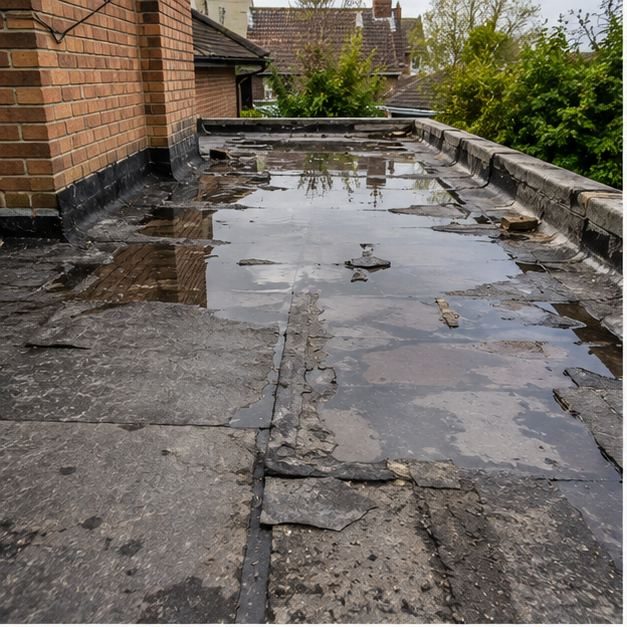
Stripping back to the deck
The old covering comes off first, down to the boards. That is the only way to see what lies underneath. We note how many layers have built up, since older roofs often have one covering laid over another, and we remove them together so the new roof sits on a clean, flat surface.
Debris is cleared as we go and the roof is not left open to rain. On a garage that sits close to a house wall, we also take care at the junction so the wall and any lead or flashing there are not damaged as the old layers are lifted. The aim is a clean deck, ready to be looked over before anything new goes down.
What we find under the covering
Water that has got through a failed covering can soften the deck. Sound boards stay; soft, stained or crumbling ones are cut out and replaced. We also look at the joists, the falls towards the outlet and the walls where the roof meets them.
- Soft or dark boards are replaced rather than covered over
- Falls are corrected so water runs to the outlet and does not sit
- Insulation is considered where the garage doubles as a workshop or room
- Upstands and edge trims are checked for rot or gaps
Choosing the covering
Single-ply rubber, fibreglass and felt systems all suit a garage. Rubber goes down in large sheets with few joints, fibreglass is formed on site as a seamless finish and felt is built up in layers. The right one depends on the shape of the roof, its edges, how much it is walked on and your preference.
Whatever the system, the finish at laps, corners and pipes matters more than the material name. A neat corner, a sealed vent and a clean edge trim are what keep rain out. Ask to see how these details will be formed, and ask who will be on site to do them.
Edges, upstands and outlets
Most failures start at the edges rather than in the middle. We fit new edge trims, form tidy upstands where the roof meets a house wall and make sure the outlet or gutter is clear and correctly set. Where wall meets roof, a flashing or sealed upstand stops water running behind the covering.
What to ask before work starts
Ask for a written description of the work, including whether the deck is being replaced, how the covering is finished at the edges and what happens if rot is found once the roof is stripped. Ask how the open roof is protected from rain overnight. Plain answers to these tell you a lot. It may need planning or Building Regulations checks — we advise before work starts.
Frequently Asked Questions
Does the whole garage roof always need replacing?
No. If the deck is sound and the faults are local, a repair can be sensible. When the covering is cracked, blistered or leaking in several places, patching stops making sense. We look at the roof and tell you which applies.
Can the new roof go over the old one?
Sometimes a new covering can go over a sound existing one, but it hides what is beneath and adds weight. On a roof that has leaked, we prefer to strip it so the deck and falls can be checked and repaired properly first.
Will I need to clear the garage?
It helps to move valuables and anything easily damaged away from the walls and ceiling before we start, as dust and debris can fall. Cars and bikes are best moved out of the way. We tell you in advance what needs clearing.
Talk to our team about flat roofing in Redland
Every roof is different — the fastest way to get an accurate answer is a quick chat with our team.