
A roof space needs a flow of air to stay dry. Vented soffits let fresh air in at the eaves so moisture can leave. Here is how that works in Redland's older houses.
The soffit is the board closing the underside of the eaves, and on a roof that breathes, part of it lets air in. Without that, warm damp air from the house sits in the loft and condenses on cold timbers. In larger older houses with big roof spaces, the effect builds quietly.
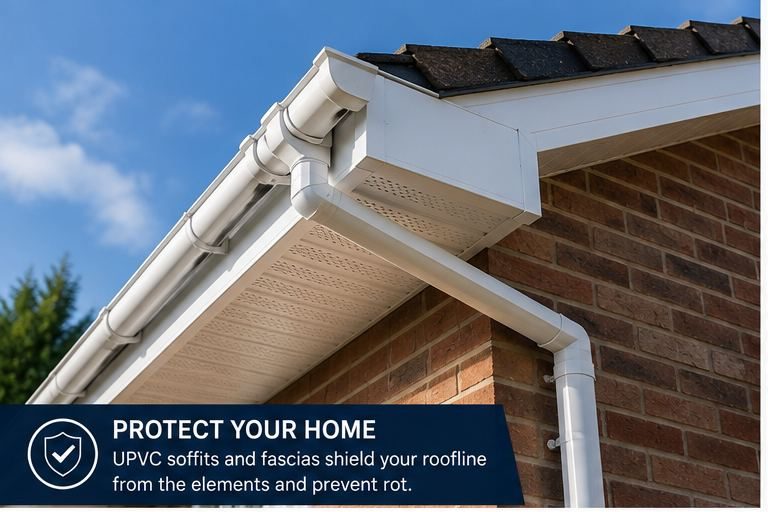
What the soffit does
Beneath the fascia, the soffit closes the gap between the wall and the roof edge. It keeps birds and weather out, but a plain solid board also shuts out the air the roof space needs. Vents turn the soffit from a simple cover into the intake side of a ventilation path.
On a house with a long run of eaves, the intake is spread along the whole edge, which helps the air move evenly. A short run of vents in only one place is far less useful. We look at how much air can actually get in, not only whether a vent exists.
How air moves through a roof space
Fresh air enters at the eaves, rises along the underside of the covering and leaves near the ridge or through other outlets. That gentle movement carries away the moisture that rises from kitchens, baths and everyday living. In a tall house with a deep roof, it matters even more.
- Vented soffit boards with slots or small holes along their length
- Continuous vent strips fitted behind the fascia
- Round vents set into the soffit at intervals
- A clear gap kept open between insulation and the roof covering
What goes wrong without airflow
Trapped moisture shows up as condensation on the underside of the roof, dark mould on rafters, damp insulation and timber that slowly softens. Stains on top-floor ceilings can look like a leak when no water is coming in from outside. Good airflow stops that problem at the source.
Over time damp timber invites rot and wood-boring insects, and metal fixings can corrode as well. Repairing that is rarely small, which is why ventilation is worth sorting out when boards are being replaced anyway, rather than being left for later when more of the roof is affected.
Insulation, loft rooms and blocked eaves
Extra insulation pushed hard into the eaves can block the intake and undo the benefit of vents. The same applies after a loft is converted into a room. We keep a clear path for air above the insulation, and where there is no path at all, we say how it can be made.
What we do when replacing soffits
We take off the old boards and gutters, then check the rafter ends and eaves for rot before anything new goes up. On older houses we also check what the existing soffit boards are made of before disturbing them. New vented soffits or vent strips go in with the fascia, then gutters are refitted.
Frequently Asked Questions
Do all soffits need vents?
Most roof spaces need some intake of fresh air, and vented soffits are the usual way to provide it. Where the roof is ventilated another way, such as at the ridge or with tile vents, we assess how the whole system works together.
Will vents let birds or insects into the loft?
Vent openings are designed with small slots or fine mesh so air gets through and creatures do not. A properly fitted vented soffit keeps birds and insects out as well as a solid one, which is one reason we recommend them.
Can I tell if my soffits are vented from the ground?
Often you can. Look up at the board under the eaves: slots, small holes or a thin strip along the edge mean it is vented. A plain solid board usually is not. Photograph what you see and we can advise.
Talk to our team about UPVC fascias and soffits in Redland
Every roof is different — the fastest way to get an accurate answer is a quick chat with our team.