
There is no single best flat roofing material. For a rear extension on an Easton terrace, the right choice depends on shape, access, how the roof is used and how well the deck is prepared.
Rear extensions and small flat roofs are everywhere on Easton's terraces, and each gets asked the same thing: which covering is best. The honest answer is that three common systems all work well when laid properly on a sound deck, and each has strengths. We help you pick by looking at the roof itself rather than a brand.
The three common systems
Single-ply rubber, often called EPDM, comes in a large sheet and suits simple shapes with few joins. Fibreglass, or GRP, is formed in place as a seamless skin and copes well with awkward outlines. Felt systems are built up in layers and are familiar, repairable and often well suited to larger or more complex areas.
Whichever you favour, the quality of the joins, edges and corners matters more than the label on the roll. We will explain how each option is finished at the walls and the roof edge so you can judge the work properly.
Shape and detail decide a lot
A plain rectangle with clean edges is a different problem from a roof with a bay, a chimney, a rooflight and a wall on two sides. The more upstands, corners and penetrations there are, the more the choice favours a system that can be shaped neatly round them. Detail work at the edges matters more than the sheet itself.
- Number of corners, upstands and abutments
- Where the roof meets a taller wall
- Rooflights, vents and pipes passing through
- How the water will drain away
The deck underneath
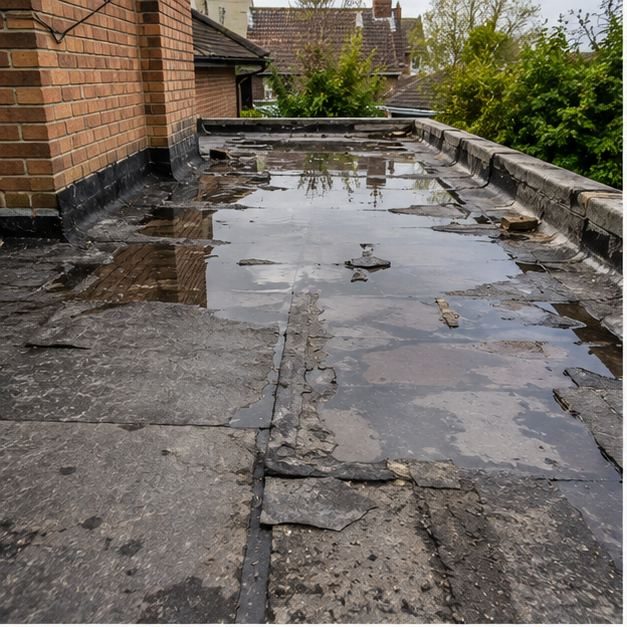
No covering performs well on a poor base. Before we recommend anything we check the deck for softness, movement and old damp, and we look at falls so the water has somewhere to go. On older extensions, an existing covering may hide a rotten deck that has to be put right first, whichever material goes on top. If the deck needs replacing, we say so before quoting for covering, so nothing is hidden under the new layer.
Insulation and how the roof is used
A flat roof extension should be warm, so we talk about insulation and how it is laid with the covering. Think too about foot traffic: a roof that is stepped on to clean a window or reach a gutter needs a surface that can take it. Tell us how you use the roof so the specification fits.
Access on a busy terrace
Tight terraces and busy streets affect materials as much as taste. Everything may have to be carried through the house or lifted over the front, which can favour lighter rolls or a system formed on site. We plan deliveries and storage with you before the work starts. Anything structural may need planning or Building Regulations checks — we advise before work starts.
Frequently Asked Questions
Is rubber better than fibreglass?
Neither is better in every case. Rubber suits simple shapes with few joins and can go down quickly. Fibreglass suits awkward outlines because it forms a seamless skin. We look at your roof and recommend the one that makes the neatest, most reliable result.
Can new covering go over the old?
Sometimes, if the existing deck and covering are dry and sound. Often they are not, and covering over wet material only traps the problem. We check for moisture and softness before deciding, and tell you what is found.
What should I ask for in the quote?
Ask for a written description of the work: what happens to the old covering, what is done to the deck, how edges and upstands are finished and what insulation is included. A clear quote lets you compare like with like.
Talk to our team about flat roofing in Easton
Every roof is different — the fastest way to get an accurate answer is a quick chat with our team.