
Standing water on a flat roof is a warning rather than a nuisance. On Easton extensions and lean-tos, the cause is usually falls, blocked drainage or a deck that has begun to give way.
Puddles that stay on a flat roof a day or two after rain are telling you something. Water that cannot leave will find any weakness in the covering. On the rear extensions and small roofs common across Easton's terraces, ponding usually has one of a few causes, and finding which matters before anything is laid over it.
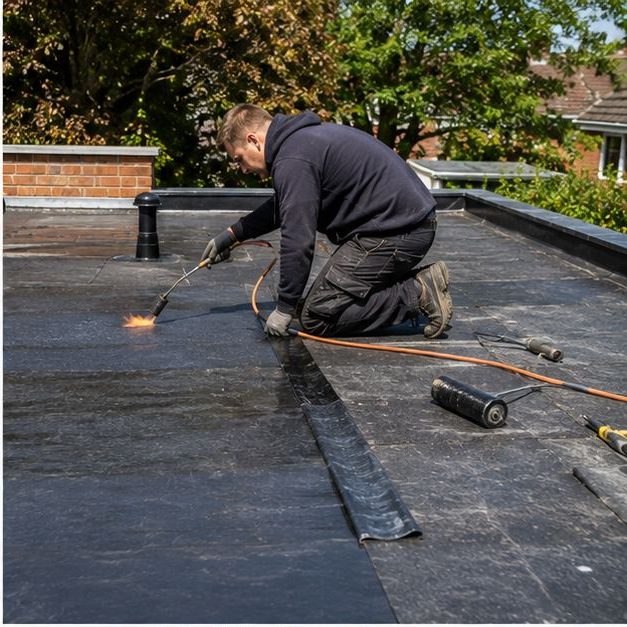
Not enough fall
A flat roof is not flat; it is laid to a slight slope so water runs to an outlet. Where the fall was too slight to begin with, or has been lost as the structure settled, water sits in the low spots. This is common on older extensions built by various hands over the decades, and it can be corrected only by changing the falls.
Blocked or badly placed outlets
Leaves, moss and silt gather at outlets and gutters, especially under trees and on shaded rear roofs. When the outlet clogs, water has nowhere to go and the whole roof fills like a tray. We clear and check outlets first, then ask whether the outlet is in the right place or too small for the area. Shaded rear roofs between taller walls are the worst for this.
- Debris packed around the outlet or gutter
- Outlets sitting higher than the lowest part of the roof
- Downpipes that are cracked, narrow, blocked or disconnected
- Overflow routes missing altogether or left unconnected
A deck that has sagged
If the deck is soft underfoot or visibly dipping, moisture has probably been working on it for some time. Boards and joists weaken, the dip deepens and the pool grows. We check for softness from inside the room below as well as from above, because a rotten deck means the covering should be lifted and the structure repaired.
Why ponding damages the covering
Standing water speeds up wear. It loads the surface, finds hairline cracks, gets under laps and joints, and freezes and thaws in cold spells. Blisters and splits often appear exactly where the pool sits. That is why we treat ponding as a cause to be solved rather than a symptom to be covered up. Fixing the cause first is what keeps the new covering from failing the same way.
Repair or replace
Where the deck is sound and the cause is a blocked outlet or one low patch, a local repair may be enough. Where ponding is widespread, the sensible route is stripping back, repairing the deck, adding falls and laying a new covering. We tell you which applies, and describe it in writing. Either way, you get the findings and the proposed fix on paper, so nothing depends on a verbal promise. Either way, you get the findings and the proposed fix on paper.
Frequently Asked Questions
Is a small puddle a problem?
A thin film that dries within a day is usually harmless. Deep water that lingers is different, because it stresses the covering and finds weak joints. If puddles are staying, have the roof looked at before they lead to a leak. Check again after the next dry spell.
Can ponding be fixed without a new roof?
Sometimes. If the deck is sound, clearing outlets, adding drainage or building up low areas can help. Where falls are poor across the whole roof, a re-lay with proper falls is the lasting answer. We explain which case you are in.
Should I clear the roof myself?
Please do not go up. Leaves and silt can be seen from a window, and gutters from the ground can be checked, but roof access should be left to us. We clear outlets safely and check what is beneath them.
Talk to our team about flat roofing in Easton
Every roof is different — the fastest way to get an accurate answer is a quick chat with our team.