
Rear extensions are everywhere in Eastville, and each one asks the same question about its flat roof. The best material is the one that suits your roof, laid on a sound deck.
Eastville's mix of Victorian terraces and later infill means a lot of rear extensions with flat roofs, and no two are the same. Rubber, fibreglass and felt systems can all give a good result. The right choice depends on the shape of the roof, what it sits against and how it will be reached and used.
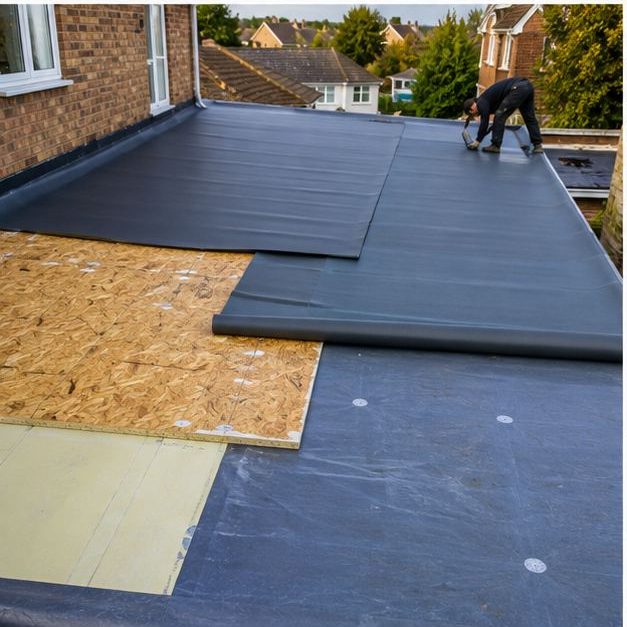
Rubber sheet
Single-ply rubber, usually EPDM, is supplied in large sheets, which suits simple rectangular roofs with few joins. It is flexible and lays quickly. Its weakness is the detailing: corners, upstands and penetrations must be done carefully with the right accessories. On a plain extension roof it can be a very sensible choice. Joins are lapped and sealed, so we show you how each one is made.
Fibreglass
Fibreglass, or GRP, is formed in place and makes a continuous skin, so there are no sheet joins. That helps on roofs with awkward outlines, tight corners or lots of penetrations. It needs a dry, firm deck and careful workmanship to avoid cracking at movement joints. The result can be smooth and neat when properly done. Because it is cured in place, laying it in cold or damp weather is avoided.
- Seamless finish on irregular shapes
- Needs a stable, dry deck beneath
- Edge trims and upstands formed in place
- Careful curing weather is needed during laying
Felt systems
Built-up felt systems use layers and are well known to many roofers. They are repairable and suit larger or more complex areas. Quality depends on laying and detailing, particularly at laps and upstands. We discuss which type of felt system suits your roof, not a single product. Many roofers know them well, which makes later repairs simpler.
The deck and the falls
Whatever you pick, the deck underneath must be sound and laid to a fall so water drains. On older extensions we often find soft boards or poor falls hidden beneath an old covering. Sorting that out is part of the job, and it matters more than the choice of sheet. Rotten boards or poor falls found under an old covering are put right before anything new goes down.
Insulation, access and details
Insulation should be part of the plan, and the covering should suit how the roof is used. Access matters on a street with parked cars and narrow routes: materials may need carrying through a house. Structural changes to the extension may need planning or Building Regulations checks — we advise before work starts. Tell us how often anyone walks on the roof so the finish suits it.
Frequently Asked Questions
Which is the longest lasting?
That depends on installation quality, the deck and the detailing more than the label. Any of the three can be done well or badly. We discuss what each depends on and recommend the one that suits your roof.
Can a new covering go over the old?
Sometimes, if the old one is dry and well bonded. Often it is not, and covering over damp or loose layers causes trouble. We check, then tell you whether stripping is necessary. Clear answers come from a proper look.
What should a quote tell me?
It should describe the covering, how the deck is prepared, what insulation is used, how the edges and upstands are finished and what happens to the old material. Clear written detail helps you compare quotes fairly.
Talk to our team about flat roofing in Eastville
Every roof is different — the fastest way to get an accurate answer is a quick chat with our team.