
Yes, they can. Fascias hold the gutter, close the eaves and protect the rafter ends, so when they fail, water and wildlife find a way in.
A fascia is easy to take for granted, until a gutter drops or paint starts peeling. Left alone, a damaged board lets water reach the rafter ends and the roof edge. For homes in Eastville, with older terraces and many rear extensions, the eaves are where a small defect can turn into a wider problem.
The job the fascia does
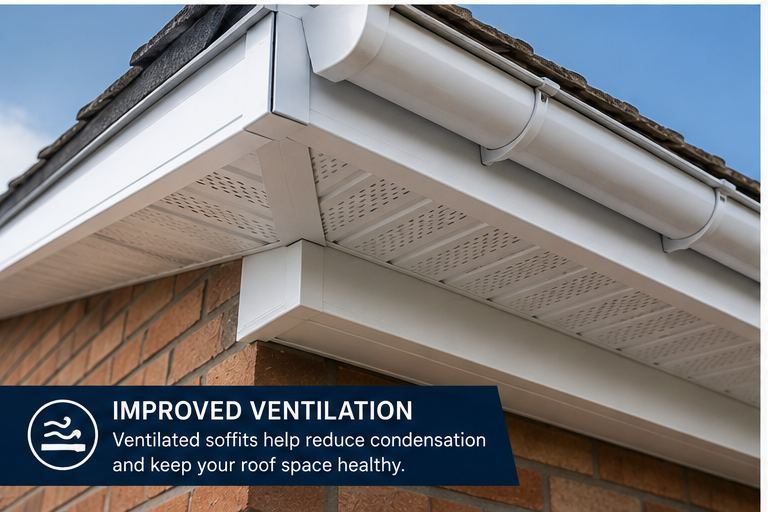
It runs along the bottom edge of the roof, fixed to the rafter ends. It carries the gutter, finishes the roof edge neatly and guards the timber behind it. If the board is sound, it keeps the gutter at the right fall and keeps weather out of the eaves. If it is not, all of that starts to go wrong. Even a neat-looking board can hide softness at its upper edge, so we test it.
Water getting behind
A split or lifted board allows rainwater to run behind it and into the rafter ends and the felt. Timber that stays wet softens, and soft timber cannot hold the gutter or the lowest row of tiles. In time, damp may show on the wall below or at the ceiling edge, a long way from the original fault. Wet felt at the eaves then draws the damp further up under the first row of tiles.
- Stains on the wall below the gutter
- Gutters that sag or drip at joints
- Rafter ends dark or crumbling
- Felt at the eaves wet or torn
Soffits and unwanted visitors
Open or dropped soffits give birds, squirrels and insects a way into the roof space, and nesting material then holds more moisture. A damaged board also lets draughts blow through. We check the whole eaves line, since a gap at one end of a row can lead to wider trouble. Bats and nesting birds can be protected, so we check before closing any gap.
Rear extensions and low roofs
Extensions often have fascias and edges at low level, with flat roofs that drain into gutters fixed to the same boards. If the board fails, the flat roof edge and gutter suffer together. Because they are low, faults here are easy to see from the ground, and worth acting on quickly. Lower roofs mean quicker checks, but the same care is needed behind the board.
What we do
We inspect the boards, soffits and rafter ends, explain what is sound and what is not, and recommend repair or replacement. Replacement covers new boards, vented soffits or strips so the roof breathes, and gutters refitted or replaced. Work needs access equipment, and we arrange it. You get the plan in writing before any work starts. Where rafter ends have gone soft, they are dealt with before new boards go on.
Frequently Asked Questions
How quickly does a damaged fascia cause trouble?
It varies. A small split may cause no harm for a time, but water gets in with every storm. Soft wood and sagging gutters are signs to act soon. We assess how far the damage has gone.
Can fascia damage cause damp indoors?
It can, indirectly. Water running behind the board soaks the eaves and may travel to the wall or ceiling edge. It rarely appears directly under the fault, which is why tracing it properly matters.
Do soffits need replacing too?
Often, if they are cracked, dropped or stained. Fitting new vented soffits or vent strips at the same time lets the roof space breathe, and avoids disturbing the eaves twice. Doing both together also saves putting access equipment up twice.
Talk to our team about UPVC fascias and soffits in Eastville
Every roof is different — the fastest way to get an accurate answer is a quick chat with our team.