
There is no single best flat roof covering, only the best fit for your extension. We set out how the main systems differ and which questions settle the choice.
Plenty of homes around Henbury have gained a rear or side extension, whether on an older stone house or an estate semi, and most of those carry a flat roof. The covering you pick matters less than how well it is detailed, but each material has its own strengths, and they suit different shapes and uses.
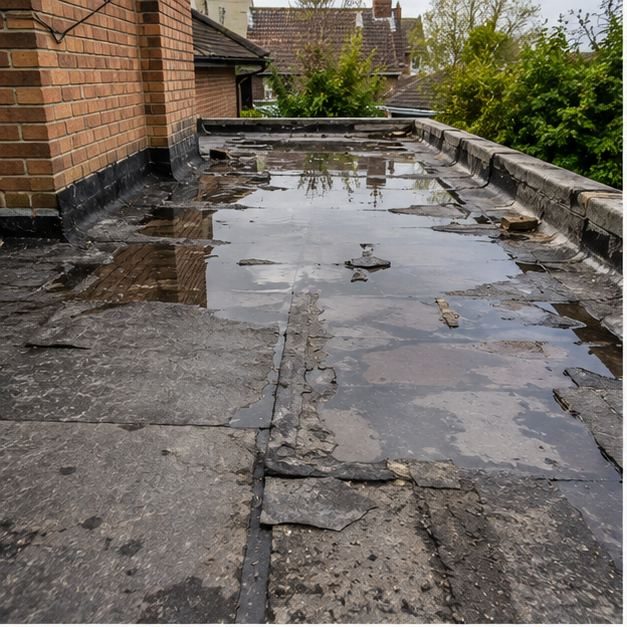
Single-ply rubber (EPDM)
A rubber membrane comes as a large sheet, so a simple roof can be covered with few or no joints. It copes well with a little movement in the structure and goes down neatly on plain rectangular roofs. It is less forgiving where there are lots of awkward penetrations and tight corners to work around.
Fibreglass (GRP)
Fibreglass is laid wet and cures into one continuous shell, which suits roofs with odd shapes, many upstands or a lot of edge detail. It is rigid and hard-wearing underfoot. It does depend on a stable, well-prepared deck, because a deck that moves can crack a rigid surface over time. On a roof with several rooflights or pipes, that wet-laid approach can leave fewer weak points.
Felt systems
Modern felt systems use layered sheets that are bonded or torched together. They are familiar, repairable and widely used on garages and extensions. Workmanship at the laps and edges decides how well they perform, so ask exactly how the joints and upturns will be finished.
Felt can suit a garage or small porch top very well. On larger roofs the choice often comes down to who is doing the work rather than to the material. Whatever you choose, expect the same questions about falls, edges and the deck beneath, because those decide the result more than the label on the roll.
What really settles the choice
The roof's shape, how much of the area you will walk on, how many things poke through it, and what the deck is made of all count. Insulation and falls matter just as much as the top layer, since a roof that holds water ages faster whichever covering is on it.
- Plain rectangle or complicated outline with upstands
- Whether the roof will be used as a terrace or storage
- Condition and type of the deck beneath
- Insulation requirement and how falls will be formed
Questions to ask your roofer
Ask what the build-up will be from deck to finish, how water will drain, how edges and wall junctions are treated, and what happens if rotten deck is found. Where the extension meets an older stone wall, ask how that junction will be sealed. A new extension roof may need planning or Building Regulations checks — we advise before work starts.
Frequently Asked Questions
Is one material always the longest lasting?
No, and we do not give figures. How long any flat roof performs depends on installation quality, drainage, ventilation and how the roof is used. A well-detailed roof in a modest material often outperforms a poorly detailed one in a premium material.
Can I put a green or decorative finish on top?
That is possible with some set-ups, but the structure and falls must be designed for the extra weight and drainage. Tell us early so we can check the deck and advise on what is sensible.
Should the old covering come off first?
Usually we strip back to the deck so we can inspect it for rot and damp and build the new layers on a sound base. Covering over the top can hide problems that return later.
Talk to our team about flat roofing in Henbury
Every roof is different — the fastest way to get an accurate answer is a quick chat with our team.