
An older roof is not automatically a failed roof. Here is how we tell a roof that needs a few repairs from one that has reached the end, and what to ask before you commit either way.
Henbury has older stone houses and cottages sitting beside inter-war and post-war estates, so roofs here vary a lot in age and make-up. The honest answer is rarely all or nothing. We look at how widespread the faults are, how the structure underneath is holding up, and whether repairs would simply be chasing the next problem.
Why age alone does not decide it
A roof that has been up a long time can still shed water well if the timbers are sound and the coverings are mostly intact. Equally, a younger roof can be in poor shape if it was laid badly. We judge what we can see and test, not the date the house was built.
On the older stone houses and cottages we take extra care to see exactly what is already on the roof before suggesting anything, because the sensible fix there can differ from the one for an estate house nearby. That is why we look before we talk about options, and why a verdict given without seeing the roof is worth very little.
Signs that point towards repair
Repair makes sense when the trouble is local: a handful of slipped or cracked tiles, a failed ridge bed, tired lead at one chimney. The rest of the covering is firm, the battens are sound and the felt underneath has not gone brittle. A tidy repair then keeps the roof working properly.
- Faults confined to one slope or one detail
- Battens and rafters dry and solid when checked from the loft
- Coverings that stay put when the wind lifts
- Leaks that trace back to a single clear source
Signs that point towards replacement
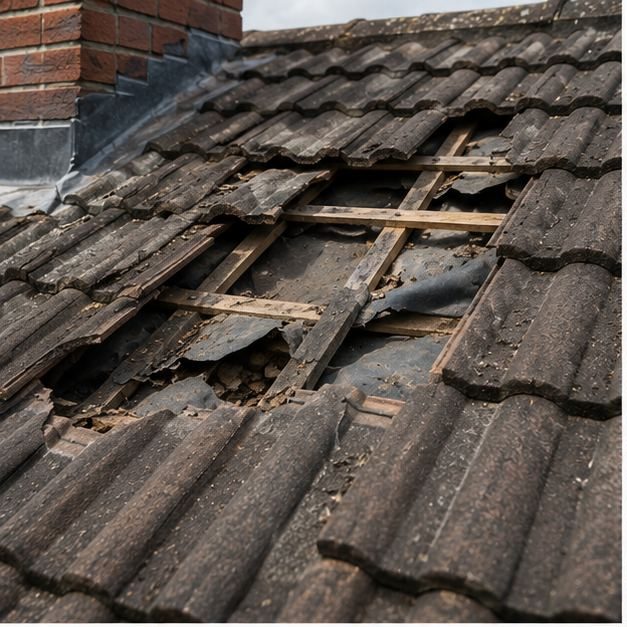
Replacement is the sensible route when the same problems keep coming back in different places. Widespread slipping, crumbling or flaking coverings, sagging lines across the slope and soft or darkened timbers all say the roof is failing as a whole, and patching it only delays a bigger job.
- Repairs that keep reappearing across the roof
- Daylight visible through the roof from inside the loft
- Damp, stained or rotten battens and rafter ends
- Felt that crumbles or is missing in places
What we check before giving a view
We start from the ground, looking at roof lines, ridges, verges and gutters. Then we go into the loft to look for daylight, damp timbers and stained felt. Water travels along timbers before it shows on a ceiling, so the visible stain is often some way from the actual fault. This ground and loft view costs you nothing in risk and tells us a great deal.
Making a sound decision
Ask for the work described in writing, with repair and replacement options laid out separately and the reasons given for each. A cottage and an estate semi may need quite different answers, so be wary of anyone who gives the same verdict over the phone. Call us and we will give you a straight opinion after a proper look.
Frequently Asked Questions
Can I repair a roof now and replace it later?
Often yes, if the structure is sound and the repair is sensible in its own right. We will say plainly when a repair is only buying time, so you can plan the larger job rather than being caught out by a sudden failure.
Will a leak always mean a new roof?
No. Many leaks come from a flashing, a ridge or a few damaged tiles. What matters is whether the leak is the only fault or just the first one to show itself, which is what the loft check helps us decide.
Does the type of house change the advice?
It can. Older stone houses and cottages may have different coverings and timbers from the inter-war and post-war estate houses nearby, so we look at each roof for what it is and do not apply one rule to all of them.
Talk to our team about roof repairs in Henbury
Every roof is different — the fastest way to get an accurate answer is a quick chat with our team.