
The fascia looks like a trim, but it carries the gutter and protects the rafter ends. When it fails, trouble often spreads into the roof edge, so it pays to act on early signs.
Fascia boards run along the bottom of the roof slope, fixed to the ends of the rafters, and they hold the gutter. Henbury has older stone houses and cottages alongside inter-war and post-war estates, and on many of them the boards have been up a long time. When they go, water finds its way into the roof edge.
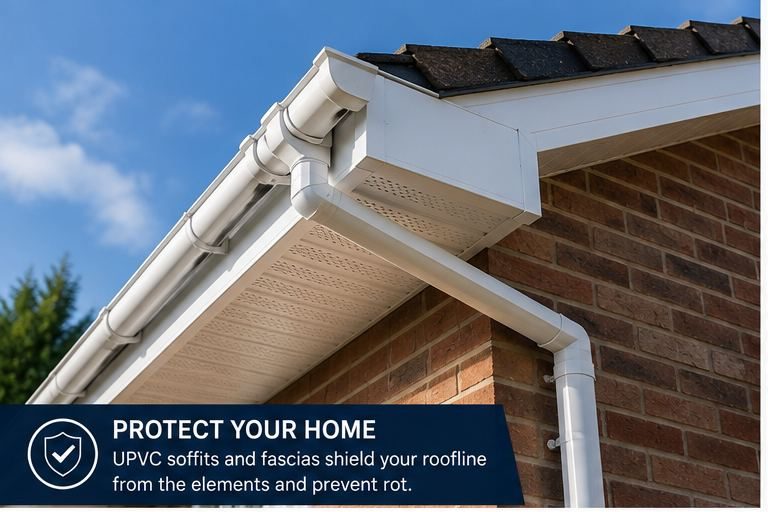
What the fascia actually does
The fascia is the board at the rafter ends that carries the gutter. Behind it sit the rafter feet and the edge of the roof felt, both of which need to stay dry. The soffit underneath closes the eaves and helps the roof space breathe. If either board fails, the whole edge is exposed. That is why a small defect at the edge deserves more attention than its size suggests.
How a damaged board lets trouble in
A split, sagging or rotten fascia lets rain run behind the gutter and soak the rafter ends. Gutters can pull away or overflow down the wall. Gaps also give birds, wasps and insects a way into the eaves, which is how many small problems at the edge become bigger ones inside the roof space. Left alone, the damp can reach the roof felt and the timbers behind it.
- Gutters sagging or pulling away from the roof edge
- Water marks on the wall below the eaves
- Gaps letting birds or insects reach the eaves
- Soft or flaking timber you can see from the ground
Signs you can spot from the ground
Look up from the garden or pavement. Peeling paint, dark patches, boards that bow, open joints and gutters that drip at the back all deserve attention. Inside, stained ceilings at the outside edge of a room can follow. Please do not go up to test the boards; a photograph from below is plenty for us to start with. Overflowing gutters in heavy rain are another clue worth noting.
What we check on site
We look at the boards, then at the rafter ends behind them, because that is where hidden rot shows. We check the eaves for ventilation and for any felt that has been left sagging into the gutter. Where older soffit boards are present, we check what they are made of before disturbing them.
- Condition of the rafter feet behind the board
- Felt dressing neatly into the gutter
- Ventilation through the soffit into the roof space
- Gutter fixings and the fall along the run
Putting it right
Replacement means taking off the old boards and gutters, checking and treating or repairing the rafter ends, fitting new boards with vented soffits or vent strips, and refitting or replacing the gutters. Access or scaffold is usually needed. UPVC is very low maintenance, cleaned rather than painted, and comes in white plus darker and wood-effect finishes.
Frequently Asked Questions
Can a damaged fascia cause a leak inside the house?
It can. Water running behind a failed board soaks the rafter ends and may follow timbers into the loft or down inside a wall. The stain on a ceiling often appears some distance from the original problem, so it needs tracing properly. We trace it properly.
Do I need new soffits as well?
Often it makes sense, because the soffit sits tight against the fascia and is usually affected by the same damp. New vented soffits also let the roof space breathe, which helps to keep timbers dry.
Can one section be repaired on its own?
Sometimes a short length can be replaced where the rest is sound. If rot has spread along the run, or the rafter ends are affected, piecemeal repairs tend not to hold, and we will tell you which case applies.
Talk to our team about UPVC fascias and soffits in Henbury
Every roof is different — the fastest way to get an accurate answer is a quick chat with our team.