
Rubber, fibreglass and felt all work well when properly laid. Which one suits a Kingswood extension depends on its size, shape and how it joins the house.
A rear extension or converted garage on one of Kingswood's older estates usually has a flat roof, and choosing the covering is a real decision. All three main systems can last well when detailed carefully. They behave differently, and the best choice follows from the size of the roof, its shape and what it has to connect to. Here is how we compare them.
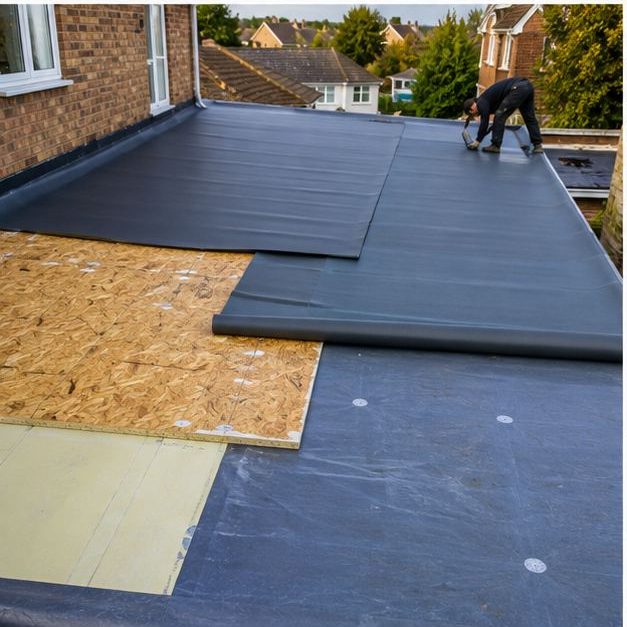
Single-ply rubber for plain, wide roofs
Rubber membranes such as EPDM come in large sheets, so a simple rectangular extension can be covered with few joints. Fewer joints mean fewer chances of water getting in. The membrane is flexible, which helps where there is movement against the house wall. Corners and penetrations need to be neatly formed to work. Wall junctions on extensions often move slightly, which a flexible sheet copes with well.
Fibreglass for corners and small areas
Fibreglass, or GRP, is laid as a liquid resin with matting and cures into one continuous skin. It handles bay tops, porches, dormer roofs and any roof with plenty of corners, because it is formed around them without seams. It needs a dry, sound deck and good conditions when it is laid. Cold or damp weather can delay the laying, so timing is agreed with you.
Felt systems for straightforward roofs
Layered felt systems are familiar, and suit garages and basic extensions where the shape is simple. The performance depends heavily on the quality of the laps and edge details. We explain exactly which layers go on the roof and where each joint sits, so the build is clear to you.
- Layers built up in a clear, described order
- Laps and joints properly bonded
- Edge trims and upstands fully detailed
- Suitable for plain shapes with few penetrations
Everything underneath matters too
A good covering on a poor deck is wasted. The boards must be dry and sound, falls must allow water to run off, and insulation should be planned with the roof. Where an extension is joined to the house, flashing and upstand detail at the junction is as important as the material across the top. Outlets and gutters must also be able to take the run-off from the new surface.
Making the choice with us
We look at the roof, the junction with the house, how often it will be walked on and what is there now. Then we tell you which materials suit it and why. You get the proposed work in writing, and the work may need planning or Building Regulations checks, which we advise on before work starts.
Frequently Asked Questions
Which material suits a garage roof?
A plain garage roof suits either felt or a single sheet of rubber, because the shape is simple. We look at the existing deck first and explain our reasoning before recommending one. Garages often have little foot traffic, which keeps the choice simple.
Does the colour or finish matter?
Mostly for appearance, though some finishes cope better with foot traffic and sun. We talk through what is available when we see the roof, without pushing a particular brand. Colour is a smaller question than the build-up beneath it.
Can I put a new covering over the old one?
Sometimes, but only if the existing covering and deck are dry and sound. Wet or rotten layers must come off, so we check before deciding rather than assuming it can go over. Laying new over old can trap moisture, which is the usual reason it fails.
Talk to our team about flat roofing in Kingswood
Every roof is different — the fastest way to get an accurate answer is a quick chat with our team.