
An older tiled roof can often be repaired for a good while, but not always. This is how we tell whether Kingswood's hipped tile roofs still have life in them.
Many Kingswood homes are inter-war or post-war, with hipped tiled roofs that have been quietly working for decades. A leak or a few loose tiles does not automatically mean a new roof, and it does not mean you can keep patching forever. The honest answer comes from looking at the roof as a whole and being straightforward about what we see.
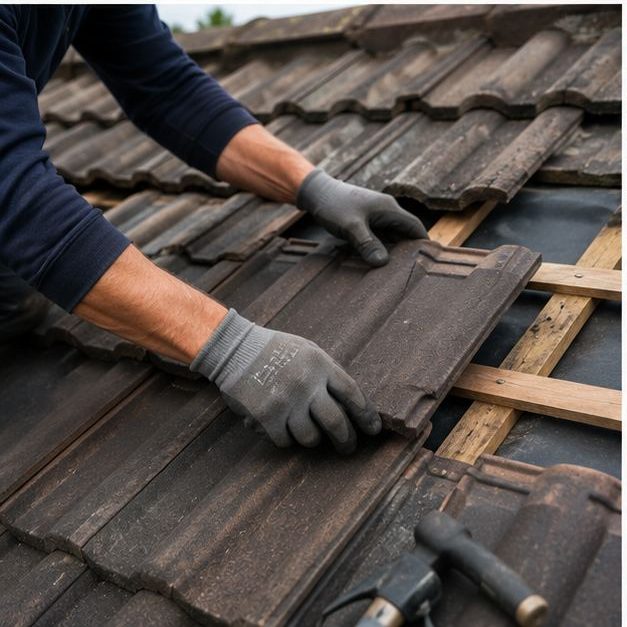
Start with the pattern, not the single fault
One slipped tile or a worn ridge is a repair. Slipped tiles in many places, widespread flaking and repeated leaks in different spots show a roof that is wearing out as a whole. We look at the pattern across every slope, because the pattern, not the single fault, tells us which way to lean. Hip ends and valleys deserve particular attention on this style of roof.
What we look for in the tiles and felt
We check the surface of the tiles for crumbling, flaking and cracks, then the underside from the loft where we can. Felt that is brittle, torn or stained, and battens that are dark or soft, tell us the roof is struggling. Daylight through the covering tells us the same. These checks take little time and answer a great deal.
- Tiles crumbling or flaking when disturbed
- Felt dry, brittle or torn in the loft
- Battens soft, dark or visibly damp
- Daylight showing where there should be none
When repair makes sense
If most of the roof is sound and the faults are localised, such as a failed ridge, a few cracked tiles or a worn flashing, repair is the sensible choice. It keeps the working parts of the roof in place and saves money that would be spent on work you do not need. We will say so plainly, even when it means a modest job. Where a roof has an extension or garage attached, the junctions are checked too.
When replacement is the better route
If the covering is failing across several slopes, patching just moves the leak. A new roof removes the old tiles, renews battens and felt where needed and relays the covering with proper ridge and hip details. For a hipped roof, the extra hip and valley work is considered during the plan, so it is done thoroughly. Garages and extensions with their own pitched sections are looked at as part of the same plan.
Questions worth asking any roofer
Ask what exactly was found, why repair or replacement is recommended, and what the work includes in writing. Ask how access is arranged, what happens if hidden damage appears and how the site is left each day. If the answer to every question is simply replace, ask for the evidence behind it.
Frequently Asked Questions
Is it worth repairing a roof that is already leaking?
If the leak comes from one failed detail and the rest is sound, yes. If tiles and felt are tired across the roof, repairs tend to be short lived, and we explain which situation you are in. The cost of repeated callouts is worth weighing too, but only once we know the roof's true condition.
Does a hipped roof change the decision?
It adds more ridge and hip work, and more junctions where problems start. That does not mean it needs replacing, but it means we check each of those details carefully before giving our view. A well-made hip needs careful bedding and secure fixing.
Will you push me towards a full replacement?
No. Our advice follows what we find on your roof. If a repair is enough, we say so, and if replacement is the honest answer, we show you the evidence first. Photographs help you see the same problem we do.
Talk to our team about roof repairs in Kingswood
Every roof is different — the fastest way to get an accurate answer is a quick chat with our team.