
The middle of a flat roof is rarely where it leaks. Edges and upstands take the strain. Here is why, and how we repair them on Kingswood garages and extensions.
Kingswood's estates are full of flat roofs on garages and rear extensions, many added long after the houses were built. When these leak, the fault is usually around the edges, not out in the middle of the covering. The edge trim, the upstand against the house wall and the joints between the two are the points where water finds a way in.
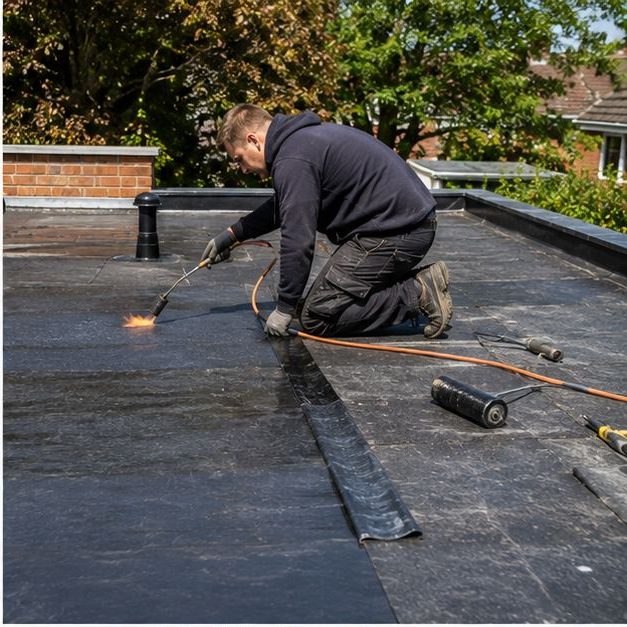
What an upstand is
An upstand is the vertical part of the covering where a flat roof meets a wall, a parapet or a rooflight kerb. The membrane turns up and is sealed or tucked under flashing. Movement between the extension and the house wall puts this junction under strain, and a split here lets water run straight down the wall. Where the extension was added later, the seam to the house is a frequent weak point.
Why edges let go
The edge trim at the front of a flat roof holds the covering in place and directs water into the gutter. If it is loose, split or fixed badly, water gets under the covering or behind the board. Fascia timber at the edge can then rot, which makes the whole edge less secure. If the fascia behind the trim is rotten, it is renewed so the new trim has something sound to fix to.
- Lifting or curling covering at the roof edge
- Cracks along the line where roof meets wall
- Staining on the wall below a flat roof
- Gutters dripping or overflowing at the edge
Joints, laps and the covering itself
Where sheets of covering join, the laps must be properly sealed. Age, sun and frost can dry out a joint, and a hairline gap is all water needs. Some systems, such as single-ply and fibreglass, have very few joins, but the details at corners and penetrations still need careful finishing. On older garages the laps may be the original ones, long past their best.
What we do about it
Where the covering is sound and the fault is a lifted upstand or a split joint, a targeted repair may be enough. We clean back, renew the affected section, reseal and fit new trims where needed. Where the failure is widespread, re-covering is more honest than stacking up patches. We also check the deck below the covering for rot.
How to describe it when you call
From the ground and inside the building, note where the stain appears, whether it follows rain from one direction and whether gutters overflow. A damp patch on the wall line is a strong hint. That information helps us go to the right place first, before we look properly at the rest of the roof. Photographs taken from the ground, with the date, are a useful help.
Frequently Asked Questions
Can a flat roof leak at the wall but not elsewhere?
Yes, and it is the most common pattern. The junction between roof and wall moves, seals age and water runs behind the upstand. The rest of the covering may still be perfectly sound. Rain from one direction often points straight at the weak spot.
Is an edge repair a lasting fix?
If the fault is localised and the deck behind is sound, yes. If rot or widespread wear is present, a repair will not hold, and we tell you that before starting. A repair holds when the cause was a single failed detail rather than a tired roof.
Should I seal it with a tub of sealant myself?
Please do not. Roof work is not for you to try, and sealant over a moving joint usually fails. Keep to ground checks and call us for a proper look. A tube of sealant rarely lasts on a joint that keeps moving and often hides the real problem.
Talk to our team about flat roofing in Kingswood
Every roof is different — the fastest way to get an accurate answer is a quick chat with our team.