
A broken fascia is not just untidy. On the hipped tiled roofs of Kingswood, the eaves are where water, birds and insects get in. Here is what to look for.
Look along the eaves of a typical Kingswood semi, terrace or garage and you will often see timber boards past their best. The fascia carries the gutter and finishes the roof edge, and the soffit closes the underside. When either fails, the effects reach into the roof. Water gets to the felt and rafter ends, and the loft stops breathing as it should.
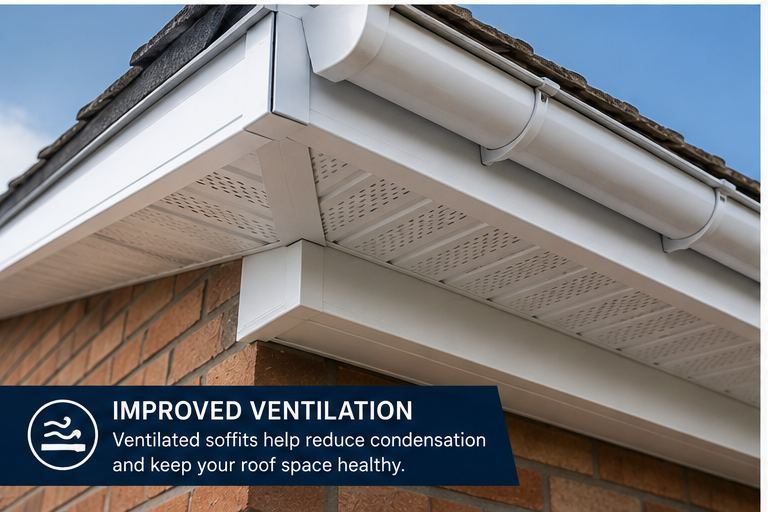
The board is part of the roof's edge
The fascia is fixed to the ends of the rafters, and the bottom row of tiles and the felt rest at its top edge. If it moves, rots or splits, that support is lost. Tiles can sit awkwardly or slip, and the felt that should guide water into the gutter may no longer do so properly. Damage at one corner often spreads along the run.
Gutters depend on it
Gutters are screwed to the fascia or held on brackets fixed to it. A weak board lets the gutter sag, and water then spills behind it and soaks the board and wall. On a hipped roof, water collects at the corners where gutters turn, which are often the first places to fail. Downpipes that are loose or blocked add to the soaking. A neat, level run of gutter shows the board behind is doing its job.
- Gutter dips between brackets or pulls away
- Water marks on the wall below the gutter
- Paint lifting in sheets or bare grey timber
- Gaps between board and wall or between joints
Soffits, birds and insects
A soffit that has cracked or dropped opens a doorway into the roof space. Birds and insects use it, and wasps especially like a quiet gap. Damp air also gets in when vents are blocked or missing, causing condensation. So the effect on the roof is both from outside, in the form of water and pests, and from inside.
What we check
From the ground, we look at the boards, the joints and the gutter line. Then we check behind the boards for rafter ends, felt and any signs of wet. If there is only surface damage, we say so and keep the job small. If timber behind is wet or soft, we explain what has to be renewed. Photographs of what we find let you see the condition for yourself.
What the fix looks like
Replacement means removing old boards and gutters, checking the eaves, fitting new boards with vented soffits or vent strips, and refitting or replacing the gutters. Scaffold or proper access is needed. The new UPVC is cleaned rather than painted and is very low maintenance. Garage and extension boards are done in the same visit so the finish matches.
Frequently Asked Questions
Can a damaged fascia let rain into the house?
Indirectly, yes. Water gets behind the board to the rafter ends and felt, then tracks into the loft or down the wall. The stain often appears near the outer edge of an upstairs ceiling. Do not ignore a stain that grows after rain. We then trace where the water enters.
Do garage and extension fascias matter as much?
Yes. Flat roofs and garage roofs rely on the edge board to hold the trim and gutter. If it fails, water can get under the covering, so these are worth checking at the same time as the house. They are best checked at the same time as the house.
Can I see the damage from the ground?
You can often see sagging gutters, flaking paint, splits and staining. What is behind the board needs a proper look from us, so please do not climb up to check it. Call us for a proper look.
Talk to our team about UPVC fascias and soffits in Kingswood
Every roof is different — the fastest way to get an accurate answer is a quick chat with our team.