
There is no single best flat roof covering. For an extension in Old Market, the right material depends on shape, access, edges and how the roof will be used.
Extensions on older terraces and commercial buildings in Old Market often finish in a small flat roof tucked between walls. The covering matters, but the detailing around it matters just as much. We talk through the realistic options with you and explain why one suits your roof better than another.
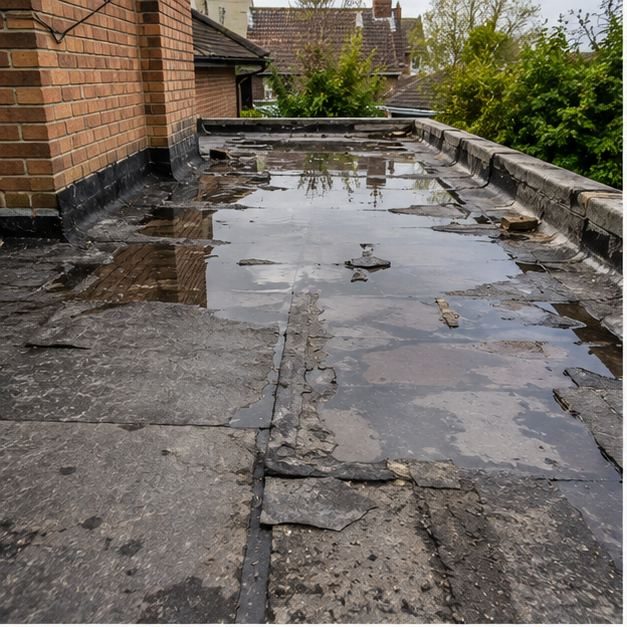
The three common systems
Single-ply rubber membrane, usually called EPDM, comes in large sheets and suits simple shapes with few joints. Fibreglass, or GRP, is laid in place as a continuous surface and copes well with awkward outlines. Felt systems are built up in layers and remain a sound choice where the detail is right. Each has strengths and limits.
Shape and size of the roof
A plain rectangle with clear edges suits a single sheet of rubber. A roof with several upstands, a rooflight or a curved edge may be better served by a fibreglass finish that wraps around every detail without joints. We measure up and look at the junctions before recommending anything, rather than quoting a favourite material.
Rubber arrives in a single piece and goes down quickly, which suits sites where long disruption is a problem. Fibreglass is laid on the spot, so it needs dry conditions and careful timing. Felt systems sit between the two. We explain which trade-offs apply to your extension before anything is ordered.
Working with walls and parapets
Extensions here often butt up to neighbouring walls or sit behind a parapet. Those abutments are where leaks usually begin, so the upstand height, the lead or trim at the top, and the way water leaves the roof matter a great deal. A good material fitted to a poor edge will still let water through.
Beneath the surface
The covering sits on a deck, insulation and a fall that sends water to an outlet. Whether you are building new or replacing, we check the structure is sound and that the roof drains properly. A flat roof extension is a layered system, and the layers need to work together. It may need planning or Building Regulations checks, and we advise before work starts.
Things to settle before choosing
It helps to know how the roof will be used and what access the builders will have. Tight central streets affect how materials are lifted, stored and kept out of the way of neighbours and passers-by, so these practical points are worth settling early.
- Will anyone walk on the roof for maintenance or access?
- Is there a rooflight, vent or pipe that needs sealing around?
- How does water leave the roof, and where does it go?
- What can realistically be delivered and lifted on site?
Frequently Asked Questions
Is rubber better than fibreglass?
Neither is better outright. Rubber suits simple shapes and fewer joints, while fibreglass handles complicated details well. The choice should follow your roof's shape, edges and use, and we explain the reasoning rather than just naming a product.
Can the material hide a poor structure?
No. If the deck is weak or the roof does not fall towards an outlet, any covering will struggle. We check the structure and drainage first so the new surface has something sound to sit on.
Does insulation affect the choice?
It affects the build-up beneath the covering rather than the covering itself, but they must suit each other. We plan the layers as one system so moisture does not get trapped and the roof stays dry.
Talk to our team about flat roofing in Old Market
Every roof is different — the fastest way to get an accurate answer is a quick chat with our team.