
No single covering wins every time. For extensions on Patchway semis, the right choice depends on the shape of the roof, the details and what you want from it.
Rear and side extensions on inter-war and post-war semis in Patchway often finish with a flat roof, and the choice of covering is one of the first decisions. Rubber, fibreglass and felt systems can all work well. What separates a good result from a poor one is mostly the preparation and detail.
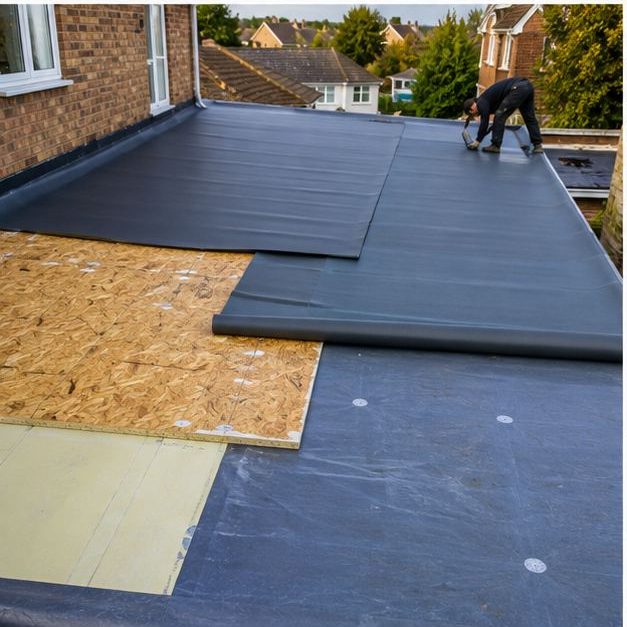
Single-ply rubber
EPDM rubber arrives as a large sheet, laid with few joins, and suits regular shapes such as a plain rear extension. It is quick to lay, which helps when the weather is uncertain. The weak points are the details, so upstands, corners and edges must be formed carefully and fixed to the manufacturer's method.
Rubber suits plain rectangles best. If the roof has several rooflights, pipes or an irregular outline, the number of cut-outs and folds increases and so does the chance of a weak point, so we weigh up whether another system would handle the shape more cleanly.
Fibreglass
Fibreglass, or GRP, is applied in place and sets into a continuous surface without joins. It handles awkward shapes, curved edges and roofs with several penetrations. It needs dry conditions while it cures and a stable deck beneath. Done well, it gives a tidy finish on garage roofs, bay tops and small porches.
Because fibreglass forms the whole surface in one go, the preparation of the deck and the choice of day matter a great deal. We would rather wait for dry weather than rush the work, since a surface laid in poor conditions never performs as well.
Felt systems
Built-up felt remains a sound choice where the detailing is right. Modern versions use layers fused together to create a robust covering. They suit larger or more complex roofs, and are often the natural choice where a new roof must match the method of an existing one. Preparation of the deck matters as much as the felt.
Where a house already has felt on a garage or porch, a matching system can make a neat transition between old and new. We check the condition of what is there before deciding whether to tie in or to renew the whole thing.
Things that matter more than the label
The covering depends on a sound deck, insulation, a proper fall to an outlet and well-formed edges and upstands. Ask how water leaves the roof and what the edge detail looks like. A new extension roof may need planning or Building Regulations checks, and we advise before work starts.
- Is the deck strong enough and dry?
- Does the roof fall towards a clear outlet?
- How are edges, upstands and trims formed?
- How will the build-up cope with insulation needs?
Matching material to your roof
We look at the shape, the number of penetrations, the access and the finish you want. On wide estate roads, delivery and lifting are usually simple, so we can use whichever system suits the roof best, not the one that suits the site. We explain our reasoning so you can compare it with other advice.
Frequently Asked Questions
Which is the most durable material?
Durability depends mostly on workmanship, drainage and detailing rather than on the label. Any of the three can perform well when fitted properly, and any can fail when rushed. We talk through the realistic differences for your roof.
Can a new covering go over the old one?
Sometimes, but only if the existing deck and layers are dry and sound. If water has got in, covering over it traps the problem. We check before deciding, and strip back where that is the honest answer.
Does the colour or finish matter?
Mostly for appearance and for how the roof sits against the house. Options vary with the system. Talk to us about how the extension is seen from the garden and the street, and we can suggest what suits.
Talk to our team about flat roofing in Patchway
Every roof is different — the fastest way to get an accurate answer is a quick chat with our team.