
On flat roofs, water seldom comes through the middle of the covering. It gets in at edges and where the roof meets a wall, which is why Patchway extensions and garages leak there.
Many homes in Patchway have a flat roof over a rear extension, garage or porch added after the estate was built. The surface may look fine while the edges and wall junctions quietly fail. These are the places that move, collect water and get least attention, so they leak first.
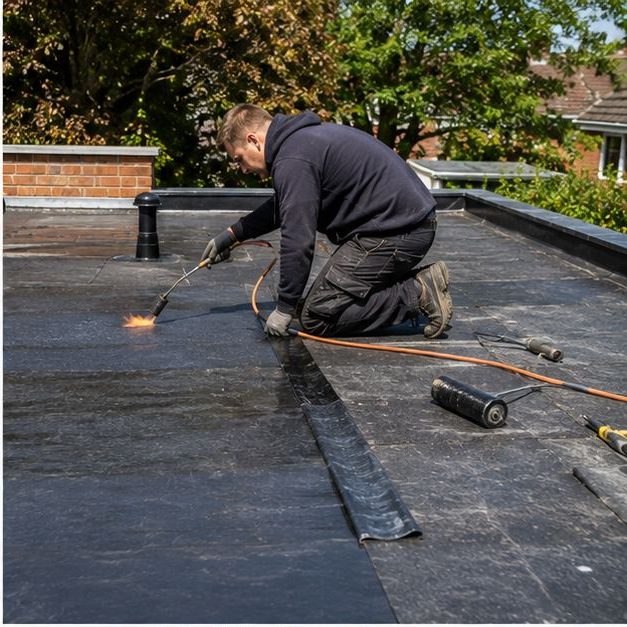
What an upstand is and why it matters
An upstand is the part of the covering that turns up the face of a wall or a kerb, so water cannot run behind it. If it is too low, unsealed or lifted, rain gets under it. Extensions tied to a house wall are especially prone, as the two structures move at slightly different rates.
Even a well-built upstand can fail if the wall behind it is crumbling or the fixings have rusted. We look at what the covering is attached to, not just the covering, because a good repair needs something solid to hold on to.
Edge trims and the drip line
At the outer edge, a trim carries water off the roof and into the gutter. When the trim cracks, lifts or is badly fitted, water can curl back under the covering and soak the deck. In windy, open spots like wide estate roads, rain is driven sideways, which exposes weak edges more quickly.
A trim is also easily knocked or bent during other work such as gutter replacement or painting. If water has been creeping in for a while, the timber behind the trim may have softened, and that has to be replaced before anything new goes on, otherwise the fresh trim has nothing sound to hold.
Problems that start with the original build
Some leaks are built in. A flat roof added in a hurry may have shallow upstands, no proper termination at the wall, or a cover strip held with sealant alone. Sealant is a short-term patch. We look at how the roof was put together, because fixing the detail is better than sealing it again and again.
What we check and how we repair
We examine the edges and junctions closely from safe access and check the deck beneath for softness where we can reach it. Repairs vary, and the right one depends on how far the damage goes and on whether the roof around it is still in good shape.
- Re-forming or extending upstands and refixing terminations.
- Replacing worn edge trims and drip details.
- Renewing sections of covering around damaged joints.
- Replacing the roof where the deck or covering has failed widely.
Warning signs you can see
From inside, look for staining along the ceiling edge nearest a wall, bubbling paint or damp on the wall above an extension. Outside, check the gutter line for overflow. These point to an edge or upstand problem, and are a reason to call us for a proper look rather than leaving it until winter.
Frequently Asked Questions
Can an upstand be repaired, or must the roof be replaced?
Often it can be repaired by re-forming or extending the upstand and refixing the termination, provided the covering and deck around it are sound. If the surrounding area is failing, a larger renewal is more honest.
Why does my extension leak where it meets the house?
The junction takes movement from two structures and relies on a well-made upstand and termination. If either is short or sealed only with a bead of sealant, water gets behind it and the leak shows inside.
Is sealant a proper fix?
Sealant can hold for a while, but it is not a substitute for correct detailing. If the same spot keeps leaking, the detail probably needs rebuilding. We explain what is wrong and what a lasting repair involves.
Talk to our team about flat roofing in Patchway
Every roof is different — the fastest way to get an accurate answer is a quick chat with our team.