
A fascia that looks only slightly tatty can still be letting water into the roof edge. This guide explains what happens behind the board on Patchway homes.
Fascias on Patchway semis run along the front, back and round the hips, so there is a lot of board for the weather to work on. When one deteriorates, the consequences are usually felt in the gutter first and the roof timbers later, which is why it is worth acting early.
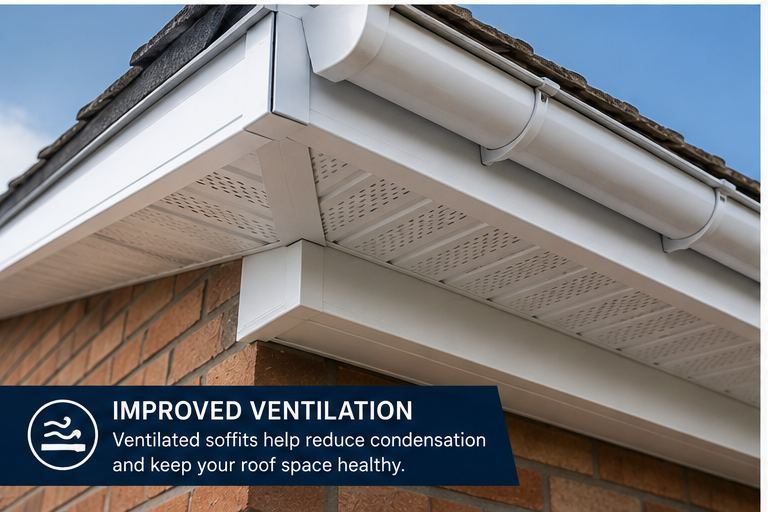
The fascia's job
The fascia sits at the rafter ends and carries the gutter, while the soffit closes the underside of the eaves. Together they protect the ends of the rafters and the top of the wall. If the fascia fails, rain that should go into the gutter finds its way behind the board instead.
On a hipped roof, the fascia changes direction at the hip ends, and the joints there are often the first to open. A small gap at a corner can pass rain straight into the eaves without anyone noticing, and it may be months before a stain tells you anything is wrong.
Water behind the board
Rotten timber lets water seep into the rafter ends and wall plate. That keeps the timber wet, speeding up decay and weakening the fixings that hold the roof edge. You may not see this from below, but the first clue is often a gutter that has dropped, leaked or started to overflow onto the wall.
Open eaves and ventilation
Damaged or missing soffit boards leave gaps for birds, wasps and damp air to enter the roof space. Blocked ventilation can lead to condensation in the loft. The roof edge is part of how a roof breathes, so a neglected soffit affects the whole space above the ceilings.
Wasps and starlings in particular like a gap at the eaves. Once they have moved in, clearing them and closing the opening are both part of a proper repair, and the soffit may need replacing as well so that the roof space is properly closed again.
What we check
We look along each run from ground level and then more closely with safe access arranged. Hips and corners deserve extra attention because water collects there. These are the signs we look for, and you can spot most of them from the garden or the road.
- Sagging gutters and stained walls beneath them.
- Peeling paint, dark patches or soft spots on the board.
- Gaps at joints or where the board meets the wall.
- Nests or insects around the soffit.
How we put it right
The sensible fix is usually to replace fascias, soffits and gutters together, check the rafter ends, add ventilation and refit everything so water goes where it should. UPVC is very low maintenance. If you can see a problem from the ground, a proper look from us will confirm whether a repair is enough.
Frequently Asked Questions
Can a fascia problem cause a roof leak?
Indirectly it can. Water that gets behind a damaged board soaks the rafter ends and wall tops, and can eventually show as damp at the edges of ceilings. It is rarely the whole story, but it contributes and should not be ignored.
Is it urgent?
Not always, but waiting makes it worse. Timber that stays wet gets weaker and the gutter may stop working. If you see overflow, sagging or gaps, have it checked before the next bout of heavy weather.
Will new boards fix the problem?
They will if the cause, usually failing gutters and poor ventilation, is dealt with at the same time. We replace the boards, check the rafter ends and sort the gutters so the problem does not return.
Talk to our team about UPVC fascias and soffits in Patchway
Every roof is different — the fastest way to get an accurate answer is a quick chat with our team.