
Plenty of older roofs in Patchway can be repaired, and some really cannot. Here is how we weigh up a hipped semi roof and give you a straight recommendation.
The estates in north Bristol were built in waves, and many roofs have now been through a lot of weather and a few rounds of patching. Deciding whether to repair or replace comes down to how much of the covering and the timber underneath is still sound, and we judge that roof by roof.
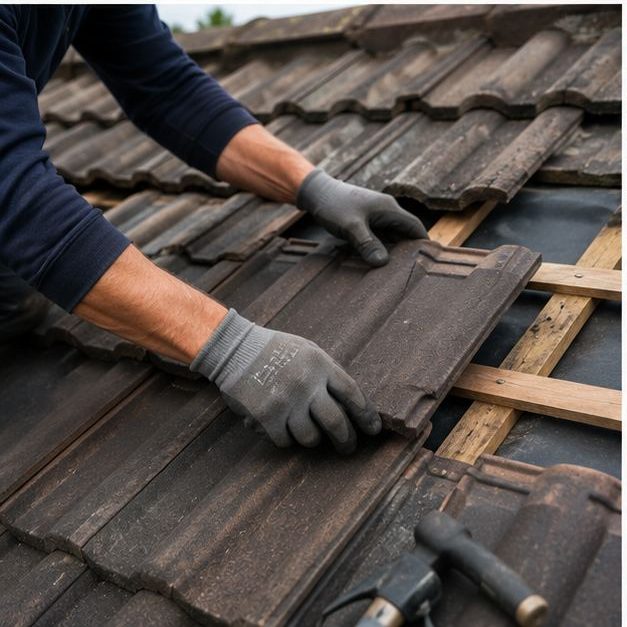
Starting with the whole roof
A semi in Patchway often has a main slope, hips on each side and perhaps a rear extension or porch roof. Faults on one section may be isolated, or they may reflect the age of all of it. We look at every slope, the ridge and hips, and the junctions before offering an opinion, because partial views mislead.
What the loft shows
Inside the roof space, we look for daylight, damp or darkened rafters, soft battens and felt that has torn or gone brittle. Dry timber and sound felt favour repair. Widespread damp, sagging or rot point towards replacement. Estate roofs of this age were often built with thin underlay, so what is under the tiles can be the deciding factor.
Estate roofs often have extensions, porches and hipped sections that were built or repaired at different times, so each part may be in a different state. We note which areas are sound and which are tired, and give you the picture as a whole rather than a single verdict.
When repair is the right call
Where tiles have slipped, a ridge has gone, or one flashing has failed and the rest of the roof is sound, repair is sensible and better value than a new covering. It deals with the actual fault without disturbing what still works. We tell you honestly when that is the case, and what we would keep an eye on afterwards.
- Faults are limited to one or two areas.
- Timbers inside the roof space are dry and solid.
- Tiles are mostly sound and lie flat.
- Previous repairs are holding up.
When replacement makes more sense
If leaks keep reappearing in different places, tiles are crumbling across whole slopes, or the felt and battens are failing, further patching tends to waste effort. A re-roof renews the covering, the felt and battens as needed, and the edge details. It is a larger job, but it resolves the roof as one piece. Larger work may need planning or Building Regulations checks, and we advise before work starts.
How to compare advice
Ask any roofer what is causing the problem, whether the proposed work deals with it, and what would happen if you waited. A good answer is specific to your roof and comes with an explanation of what is urgent and what can wait. You should not be rushed into a decision, and the description of work should be clear.
Take your time over the decision. A sensible roofer will describe the work clearly, explain how access is arranged on your drive or road, and keep the site tidy. If something does not add up, ask again, and call us for a proper look at the roof.
Frequently Asked Questions
How do I know if my roof has reached the end?
The signs are repeated leaks in different places, crumbling or flaking tiles across large areas, sagging lines and damp timbers inside. One slipped tile does not mean the roof is finished. We look at the pattern and explain it.
Will you say if a repair is enough?
Yes. If a repair will do the job properly we say so and do not suggest more. The aim is to solve the problem in front of us and tell you honestly what the roof is likely to need later.
Does a hipped roof change the decision?
It adds ridge and hip lines that need care, and these are common weak points. They can often be fixed without touching the rest of the covering, which keeps repair a realistic option on many hipped semis.
Talk to our team about roof repairs in Patchway
Every roof is different — the fastest way to get an accurate answer is a quick chat with our team.