
The middle of a flat roof is rarely where it leaks. The edges, trims and upturned walls take the real punishment, and this is how we find and mend them.
Garages, porches and rear extensions are a feature of the semis across Brentry, and most have a flat roof where it meets a house wall or finishes at an edge. Those details are the weakest part of any flat roof. When they leak, the covering across the middle often turns out to be perfectly sound.
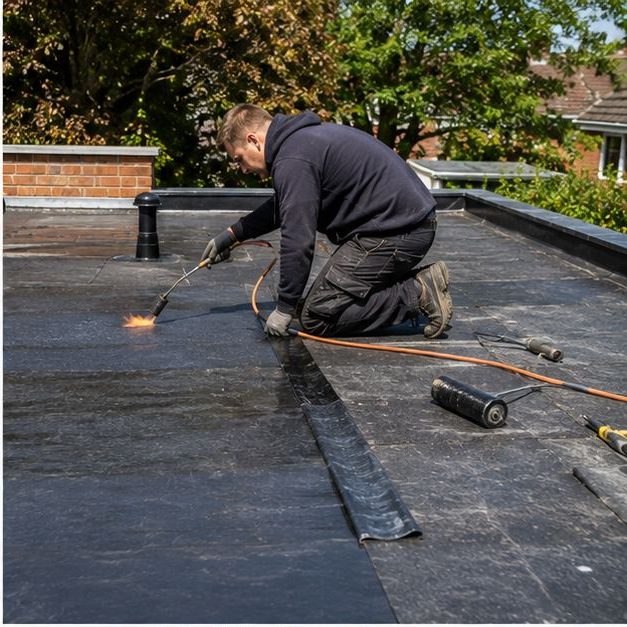
What an upstand is
An upstand is the upturned edge of the covering where the flat roof meets a wall or other upstanding surface. It has to be fixed, sealed and capped so water cannot run behind it. Because the house wall and the roof move at slightly different rates, the seal at the top is under constant strain.
On a garage or porch roof beside the house wall, the join is often hidden behind a rendered or painted strip, so a leak can be there for a long time before a stain appears on the ceiling or the inside of the wall.
Why upstands fail
Typical causes are sealant that has dried out and cracked, covering that has lifted or slipped off the wall, flashings with open laps and mortar joints that have let water in above the upstand. A wall that has absorbed rain can also feed damp down into the roof edge, which is easy to mistake for a fault in the covering itself.
- Cracked or missing sealant along the top
- Covering peeling away from the wall
- Open laps or loose flashing above
- Damp patches on the inside wall beside the roof
Edges and trims
At the outer edge, a metal or plastic trim guides water into the gutter. If the trim is bent, rusted or has come away, water slips behind it and into the deck. Corners are especially exposed. Garage roofs with a short drip edge can send rain straight down the wall, staining the brickwork as a clue.
A blocked gutter can also back water up under the trim, which we check at the same visit. If the gutter and trim are both in poor shape, it often makes sense to deal with them together while access is in place.
Repair or rebuild
If the edges are the only problem and the deck is dry and firm, we can often renew a trim, redress an upstand or reseal and re-flash the junction. Where the deck has rotted along the edge, we cut out and renew it first. Widespread failure of the edge details usually means re-covering the roof properly.
What to ask
Ask how the upstand will be formed, how the top edge will be sealed and what is being done about the trim. Ask whether the deck has been checked for damp. If any work may need planning or Building Regulations checks, we advise before work starts. Careful detail is what keeps these roofs dry.
Frequently Asked Questions
Can an upstand leak be fixed with sealant?
Sometimes sealant is part of the answer, but a surface smear rarely lasts. We look at why the join opened up. If the covering has pulled away or the flashing has failed, the junction needs redoing properly.
Why do I see damp on the inside wall beside a flat roof?
It usually means water is getting in at the upstand or the junction with the house wall, rather than through the middle of the roof. Checking the flashing and the sealant along the top edge normally finds the route.
Is edge trouble a sign the whole roof needs replacing?
Not necessarily. If the covering and deck are sound, repairing the edges can be enough. We inspect the whole roof, tell you what we find and only recommend replacement where the damage is widespread.
Talk to our team about flat roofing in Brentry
Every roof is different — the fastest way to get an accurate answer is a quick chat with our team.