
Some fascia faults can be put right with a repair, and some cannot. Here is how we decide for the houses, garages and extensions of Kingswood.
Kingswood has a great many inter-war and post-war houses with timber fascias that have been painted, patched and painted again. At some point the board is beyond help. Deciding when a repair is honest and when replacement is the better answer depends on how far the rot has gone, what lies behind the board, and how much of the run is affected.
What counts as a repair
If a board is firm along most of its length and only a small patch is soft, a repair can be sound sense. A joint that has opened, a short length of damaged timber or a loose fixing can be dealt with by cutting out and renewing that section. The repaired area must be dry and the rafter ends behind it checked first. A repaired board still needs priming or sealing correctly.
What tips it towards replacement
Rot that runs along the board, soft timber at several joints, or boards that crumble when probed all point to replacement. So do rafter ends that have been affected by damp. Another reason is the gutter: sagging and overflowing gutters usually mean the board no longer holds them properly, and refitting the gutter to a failing board does not last. Where the gutter is the real culprit, we say so rather than replace boards unnecessarily.
- Soft, spongy or crumbling timber in many places
- Board splitting or pulling away at joints
- Gutters sagging or no longer sitting level
- Rafter ends damp, dark or soft behind the board
What replacement involves
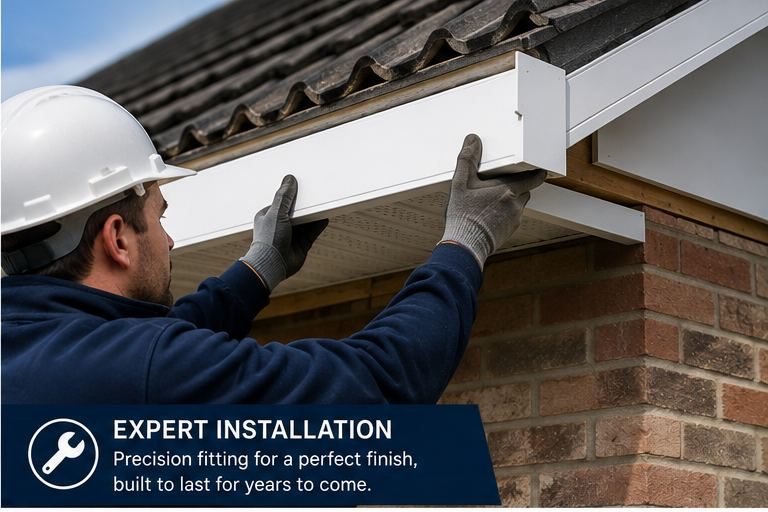
We remove the old boards and gutters, check the rafter ends and eaves, fit new fascia boards and soffits, add vented soffits or vent strips so the roof space breathes, and refit or replace the gutters. Scaffold or proper access is needed. The finished boards are UPVC, which is cleaned rather than painted and is very low maintenance. Old gutters are replaced when they are cracked or badly worn.
Garages, extensions and older homes
Garage and extension fascias are often a different board from the house, so they can fail at different times. Doing the whole run together keeps the finish consistent. On older houses, we check what the existing soffit boards are made of before disturbing them, as a calm routine step, then proceed accordingly. We tell you what we find rather than assume it matches.
What to ask before agreeing
Ask whether a repair would genuinely last, what condition the rafter ends are in, and what ventilation is included. Ask which colour and finish are available, including white, darker shades and wood-effect, and how the site will be protected. A written description of the work makes any comparison fairer.
Frequently Asked Questions
Is repairing a fascia ever worth it?
Yes, when the damage is small, the rest of the board is firm and the area behind it is dry. If rot is widespread, a repair only delays a larger job, and we say so honestly. A short, honest repair is a fair outcome. We explain what we found.
Do I have to replace the soffits as well?
Not always, but they are usually removed during the work and are often renewed at the same time. This also lets us fit proper ventilation so that the roof space breathes. Good ventilation helps stop damp building up under the roof. Matching colours can be discussed with you.
Will new boards match my house?
UPVC comes in white, darker shades and wood-effect finishes, so a good match is usually possible. We talk through the options on site, with the roof and walls in view. We talk through the options on site.
Talk to our team about UPVC fascias and soffits in Kingswood
Every roof is different — the fastest way to get an accurate answer is a quick chat with our team.