
Ridge tiles and lead flashings are two of the most common repair jobs on Patchway semis. This guide explains what each repair involves, step by step, and how to tell when one is due.
On the hipped roofs of Patchway's inter-war and post-war semis, the ridge and hip lines make up a good share of the roof's length, and they take the worst of the wind. Lead flashings do the same job at chimneys and walls. Both fail slowly and are worth understanding before anyone gets a price.
What ridge and hip re-bedding means
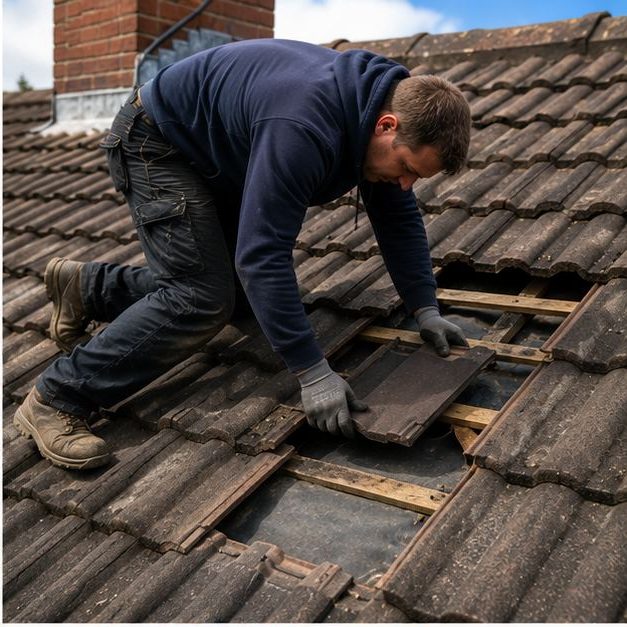
Ridge and hip tiles are held on a bed of mortar or on a dry-fixed system. Over time the bedding cracks, shrinks and lets go, and tiles loosen. A repair removes the loose tiles and old bedding, cleans the line, re-beds or refixes the tiles, and pointing or ventilation pieces are finished neatly. Hipped roofs have several lines to cover, so the job is usually longer than it looks from the road.
Signs the ridge needs attention
Most of these signs show from the pavement, which is handy on wide estate roads where you can stand back and see the whole roofline. Please do not go up to check them yourself, because roofs are slippery and dangerous. Here is what to look for from the ground.
- Ridge tiles sitting at an angle or visibly out of line.
- Crumbs of mortar in gutters or on the path below.
- Gaps along the hip lines where daylight shows.
- Damp patches on top-floor ceilings after wind-driven rain.
What lead flashing does and how it fails
Lead flashing seals the joint where the roof meets a chimney, a wall or a dormer. It lifts, splits or pulls out of its chase as the building moves and the weather works on it. Sealant smeared over a gap rarely lasts. A proper repair lifts the old lead, checks the surface behind, and fits new lead dressed to the roof covering.
Chimney flashings are often the most intricate part, with step flashings up the sides, an apron at the front and a back gutter behind. Each piece has to overlap the next so water is led away, which is why a rushed patch often fails.
Checking before we start
Before any repair we look inside the loft where possible for stained felt, damp timbers and daylight. Water seen at a ceiling may have entered at a chimney flashing or a loose ridge tile some distance away. We trace it first so the repair deals with the cause and not only the mark that appeared.
If the loft is boarded or crowded with belongings, a clear route to the area under the chimney or the ridge makes the check quicker and more thorough. It helps to clear a path before we arrive, and we will tell you what we need when we book the visit.
What to ask any roofer
A fair description of the work covers which sections are being re-bedded, whether the lead is being replaced or patched, and how access is arranged. Estate semis usually allow easy access from the front, and we agree where materials are kept so drives and paths stay usable. Expect an explanation of what is urgent and what can wait, and a tidy site at the end of each day.
Frequently Asked Questions
Can lead be repaired, or does it need replacing?
Small splits can sometimes be repaired, but lead that is lifting, thin or pulling away from the wall is usually better replaced along that section. We look at how much is affected and give you an honest judgement.
Is re-bedding the ridge a big job?
On a hipped roof it covers more length than people expect, but it is a standard repair. It does not usually involve touching the rest of the covering unless something else turns up while we are up there.
Will a ridge repair stop my leak?
Only if the leak came from the ridge. We check the loft and the other likely routes first, because water often shows up away from where it enters, and the right repair depends on finding the true source.
Talk to our team about roof repairs in Patchway
Every roof is different — the fastest way to get an accurate answer is a quick chat with our team.