
Sometimes a short length of fascia can be mended; sometimes the whole run needs to go. Here is how we decide on Patchway semis and what is involved.
Semis in Patchway typically have a long run of fascia and soffit along the front, back and hips. A fault in one spot does not always justify replacing everything, but it often shows that more of the board is on its way out. We look at the whole run before advising.
When a repair makes sense
If the damage is limited to one short section and the boards either side are sound, a local repair can be reasonable. A loose board can be refixed, a small split dealt with, or a short length replaced. The condition of the timber behind and the gutter fixings must be good for this to hold.
Even for a repair, we check the rafter ends behind the board. If they are damp or soft, covering them with a new section would only hide trouble, and the sensible choice may be to widen the job there and then rather than coming back.
When the whole run should go
Rot rarely stays in one place. If paint is bubbling along several boards, the timber is soft, or the gutter will not hold its line, replacement of the entire run is more honest. Piecemeal patching on a long, hipped roofline tends to leave mismatched sections and new faults appearing next door.
- Soft or crumbling timber in several places.
- Gutters sagging or overflowing along the run.
- Paint repeatedly failing despite repainting.
- Gaps and open joints letting in birds and insects.
What replacement involves
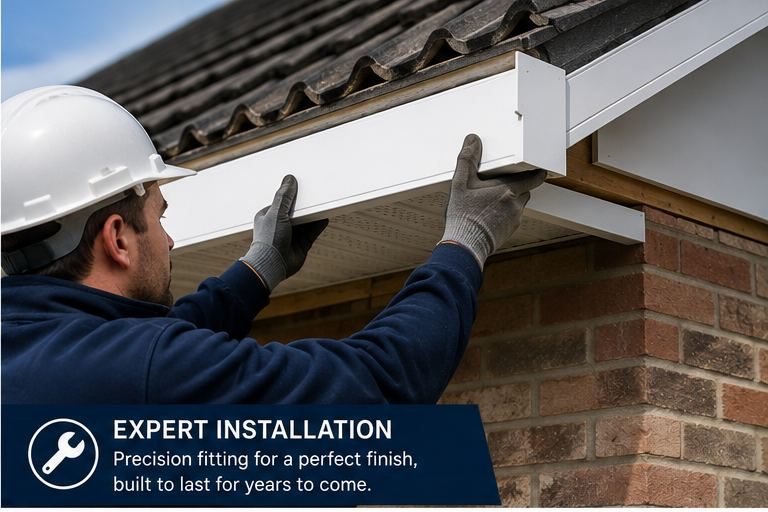
We remove the old boards and gutters, check the rafter ends and eaves, fit new fascia and soffit boards, add vented soffits or vent strips so the roof space can breathe, and refit or replace the gutters. Access or scaffold is needed for the higher runs. The result is a continuous, tidy line round the whole house.
On a long semi run, the corners and hips take extra care. The boards are cut and joined so water runs away from the joints, and the soffit is fixed so the vents sit evenly along the eaves, which gives a neat result.
The choice of finish
UPVC is very low maintenance and is cleaned rather than painted. White is the usual choice on estate semis, with darker and wood-effect finishes available if you want something different. On older homes, we check what existing soffit boards are made of before disturbing them, and take care accordingly.
Questions worth asking
Ask what is wrong with the existing boards, whether the rafter ends have been checked, and whether ventilation is included. A fair answer will cover each, explain why a patch or a full run is proposed, and describe how the gutters and access will be handled.
Another useful question is how older soffit materials are handled. We check what existing soffit boards are made of before disturbing them, so that nothing is broken up or removed in a way that causes difficulty later on, and we tell you calmly what we find.
Frequently Asked Questions
Can I just replace the worst board?
Sometimes. If the rest of the run is sound and the gutter fixings hold, a local fix can be fine. If the neighbouring boards are close behind it, replacing the whole lot avoids repeated visits and mismatched sections.
Do the gutters have to come off?
Almost always, since they are fixed to the fascia. They are taken down, then refitted or replaced with the new boards. It is a good opportunity to check falls and joints and put any faults right.
Why add vented soffits?
A roof space needs airflow to stay dry. Vented soffits or vent strips let air move through the eaves, reducing condensation and protecting the timbers. It is a small addition that makes a lasting difference.
Talk to our team about UPVC fascias and soffits in Patchway
Every roof is different — the fastest way to get an accurate answer is a quick chat with our team.