
Plenty of Bradley Stoke roofs are now old enough to show wear, but wear alone does not mean a new roof. This guide explains how we decide whether repairs will hold or replacement is the sounder choice.
Bradley Stoke grew as a planned town in the late twentieth century, so many of its concrete tiled roofs are reaching an age where faults start to appear together. The real question is rarely about one slipped tile. It is whether the whole roof still does its job, and that means looking beneath the surface as well as at it.
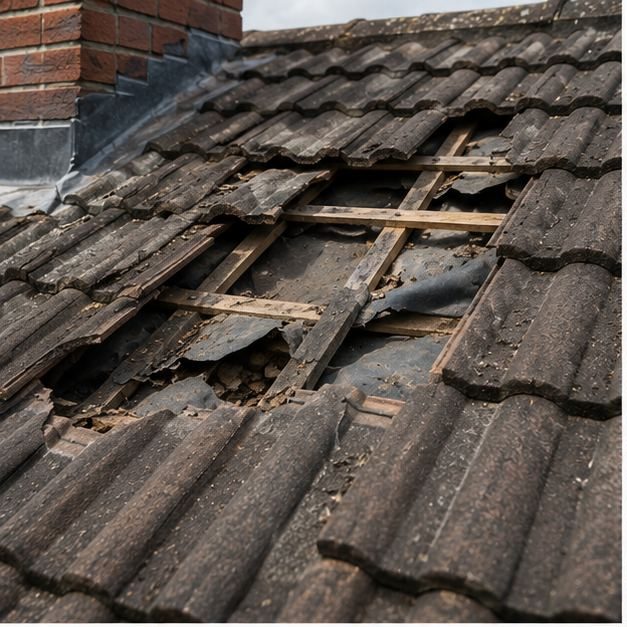
Signs the roof is only tired, not finished
A roof can look weathered and still be sound. Mossy tiles, a few slipped pieces near a gable or a cracked ridge section are usually repairable. What matters is whether the problems are scattered or spread across a whole slope, and whether the tiles themselves are firm or crumbling at the edges.
Short verges and gable ends are worth a glance from the ground, since the mortar there is often the first thing to give out on estates of this age. A few loose edge pieces do not decide anything on their own, but they tell us where to look more closely.
What we look at from the loft
Most of the answer is in the roof space. We look for daylight where none should be, dark staining on the underlay, damp rafters and battens that have gone soft. Water often travels a long way along timbers before it shows on a ceiling, so a stain in a bedroom can have its cause somewhere else entirely.
- Torn, sagging or brittle underlay
- Damp or discoloured battens and rafters
- Daylight around tile edges or the ridge
- Nails that have rusted or worked loose
When repair is the sensible answer
If the felt and timbers are sound and the faults are local, repair is honest and good value. That could be re-bedding a ridge, replacing broken tiles, renewing a lead flashing or fixing a verge where mortar has dropped. We will tell you plainly if a repair is likely to buy you a good stretch of use.
When replacement makes more sense
Where tiles are breaking in many places, battens are failing and the underlay has perished, patching becomes a run of call-outs. A strip and re-roof deals with the cause in one go. It also lets us fit new battens, a fresh underlay and dry verge units, so the edges are no longer left to wet mortar.
- Faults spread across several slopes
- Repeated leaks after earlier repairs
- Underlay that tears when touched
- Tiles that flake or split when lifted
What to ask before you decide
Ask for the findings in writing, with the roof faults described and what each option would and would not solve. A good roofer will say what is urgent and what can wait. If anything about the work may need planning or Building Regulations checks, we advise before work starts.
Frequently Asked Questions
Can I just patch a leak and see how it goes?
Sometimes, yes. If the leak comes from one broken tile or a failed flashing and the rest is sound, a repair is reasonable. We would still check the loft so the patch is not hiding a wider problem that will return after the next heavy storm.
Will a repair be wasted if I replace later?
Not usually. A small repair that stops water getting in protects the timbers and ceilings meanwhile. If we can already see that a full re-roof is coming, we will say so, and suggest only the repairs that are really needed to hold things steady.
Can you tell the condition without going on the roof?
We can learn a lot from the ground and from inside the loft, and we go onto the roof ourselves where a closer look is needed. For you, the useful checks are from inside and from the garden. Anything higher is for us to do.
Talk to our team about roof repairs in Bradley Stoke
Every roof is different — the fastest way to get an accurate answer is a quick chat with our team.