
A fascia looks like trim, but it holds up the gutter and shields the ends of the rafters. When it fails, the damage rarely stays at the edge of the roof.
On the planned estates of Bradley Stoke, the fascia board is often the first part of the roofline to show its age, with flaking paint, sagging gutters or gaps along the eaves. Homeowners tend to treat it as cosmetic. In fact a damaged fascia can let water reach parts of the roof that are far harder and dearer to fix.
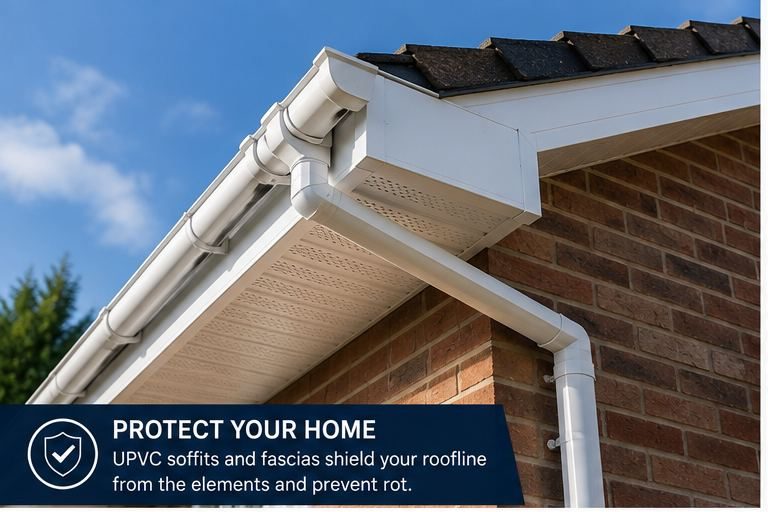
What the fascia actually does
The fascia is the board fixed across the rafter ends, and it carries the gutter. It also gives the bottom row of tiles and the underlay somewhere solid to finish. If the board is rotten, split or pulled away, the gutter loses its support and the edge of the roof stops being properly closed against rain, wind and birds.
How water gets past a bad board
Once a fascia is cracked or soft, rain runs behind it onto the rafter ends and the eaves timbers. The underlay can be pushed back by a sagging gutter, and water then tracks into the roof instead of dropping into the channel. Damp timber at the eaves rots quietly, so the first sign indoors can be a stain high on a wall.
Overflowing gutters on a loose fascia make this worse, because the water lands exactly where the roof is least protected. Over a few winters that wet edge can soften rafter ends, and by then the job has grown well beyond a simple board change.
- Gutters that sag or drip behind the pipe
- Gaps between the board and the soffit
- Peeling paint or soft, dark patches on timber
- Staining on outside walls below the eaves
Soffits and the roof space
The soffit closes the underside of the eaves and usually carries the vents that let the loft breathe. A broken soffit lets in birds, wasps and damp air, and blocked vents can lead to condensation in the roof space. Where homes have older boards, we check what the existing soffit is made of before we disturb it, and plan around it.
What we check and fix
We look at the fascia from the ground and then closely at the rafter ends and eaves. If the rafters are sound, we remove the old boards and gutters, fit new boards, add vented soffits or vent strips so the roof can breathe, and hang the gutters again. Scaffold or proper access is needed, so this is not a job to try from a ladder.
Telling a small fault from a big one
A loose section or a small split may be repaired if the timbers behind it are sound. A run of soft, sagging or lifting boards usually means replacement. Photographs and a clear written explanation help you judge the difference. If any work may need planning or Building Regulations checks, we advise before work starts.
Frequently Asked Questions
Can a damaged fascia cause a leak inside the house?
Yes, though it usually takes a while. Water behind the board soaks the rafter ends and the eaves, then travels inwards along timbers and underlay. Indoors it can show as damp near the ceiling edge or on an external wall.
Is it better to leave a fascia until it fails?
Waiting usually means more repair, not less. Rotten rafter ends and wet eaves add work that a timely board change would have avoided. Looking at the roofline sooner lets us tell you honestly whether the problem is still small.
Do UPVC boards need much looking after?
They are very low maintenance. They are cleaned rather than painted, and a wipe down now and then is enough. They still rely on correct fixing and ventilation, so a visual check of the gutters from the ground each season is sensible.
Talk to our team about UPVC fascias and soffits in Bradley Stoke
Every roof is different — the fastest way to get an accurate answer is a quick chat with our team.