
Post-war roofs on open, windy ground often reach a point where patching stops making sense. Here is how we judge whether repair or replacement is the honest answer for your house.
Many homes around Kingsweston Hill and the Lawrence Weston side were built after the war, and their roofs have taken decades of weather on high, open ground. A few slipped tiles do not mean the whole roof has failed. Equally, a run of small repairs can hide a covering that is giving up. This page explains how we tell the two apart.
Why exposure changes the question
Higher ground with little shelter means wind gets under tiles and along the edges far more than it does in a sheltered street. An older roof here tends to show its age at the ridge, the hips and the verges first, because those are the places the wind works hardest. So we look at where the damage sits, not just how much of it there is.
What we look at from the ground and the loft
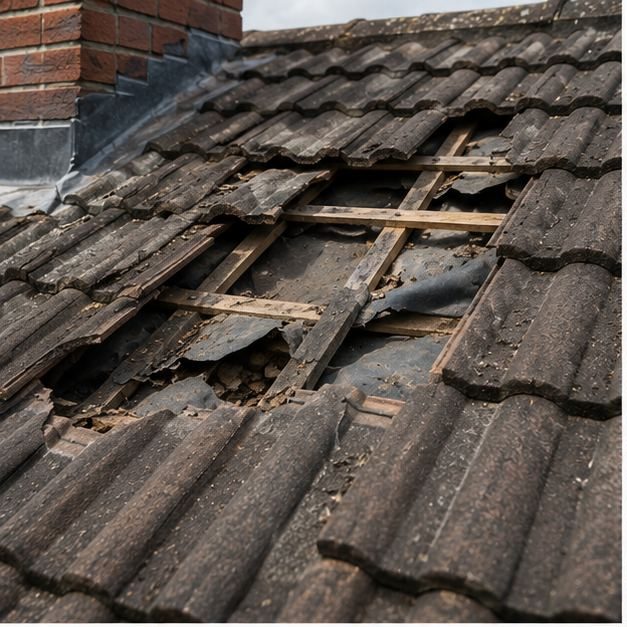
Before anyone goes near the roof we look at the whole picture from outside: dipped lines, loose or sliding tiles, patchy moss and a gutter line that has shifted. Inside, we check the loft for daylight through the covering, dark or soft timbers and stained felt. Those signs tell us whether water is getting in at one spot or across a wide area.
- Daylight showing between tiles or around the ridge
- Damp, dark or soft patches on rafters and battens
- Stained, torn or brittle felt under the covering
- Sagging or uneven roof lines seen from the road
When repair is the sensible answer
If the tiles are mostly sound and the trouble is confined to a handful of slipped or cracked ones, a failed ridge bed or worn flashing, repair is usually the right call. A well-judged repair leaves the rest of the roof working and avoids paying for work that was not needed. We will say plainly when that is the case, even if it means a smaller job.
When replacement is the honest answer
If tiles are crumbling or breaking as they are lifted, the felt has perished, and battens are rotten in several places, repairs only chase the problem round the roof. Replacing the covering in one go is then more sensible than returning every winter. We explain what we found, show you photographs of the problem areas, and let you decide with the facts in front of you.
What to ask any roofer before you decide
Ask for the findings and the proposed work in writing, in plain wording, so you can compare like with like. Ask how access will be arranged, what will happen if hidden damage turns up once tiles are lifted, and how the site will be left tidy. A roofer who explains what is urgent and what can wait is worth listening to.
- A written description of the work, not just a total
- How hidden rotten timber would be dealt with and agreed
- What can wait a season and what cannot
- How scaffold or access will be arranged
Frequently Asked Questions
Does one leak mean I need a new roof?
Not usually. A single leak most often comes from one failed detail such as a cracked tile, a worn flashing or a crumbled ridge bed. We trace it to the real source first, then tell you whether the rest of the roof is sound enough to leave alone.
Can an older roof be repaired more than once?
Yes, provided the tiles and timbers around the repair are still sound. If each repair is followed by a new problem close by, that pattern is usually a sign the covering as a whole is tiring, and we will say so when we see it.
Will you tell me if I do not need a new roof?
Yes. We give you the same plain answer whichever way it goes. If a repair does the job we say so, and if the roof really is past repairing we show you why before anything is agreed.
Talk to our team about roof repairs in Kingsweston
Every roof is different — the fastest way to get an accurate answer is a quick chat with our team.