
A tired fascia looks like a cosmetic issue, but it holds the gutter and protects the rafter ends behind it. Here is how damage there spreads into the roof itself.
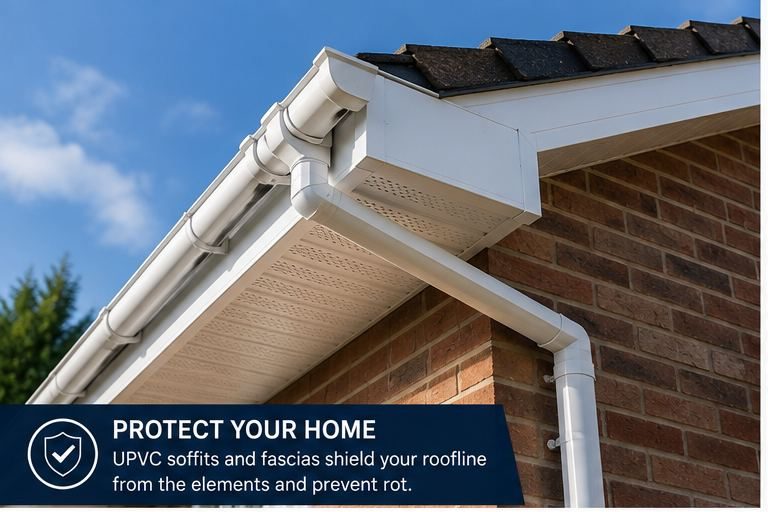
The fascia is the board along the bottom edge of the roof, fixed to the rafter ends and carrying the gutter. On the open, wind-exposed ground around Kingsweston Hill, post-war eaves take a steady battering. When the board fails, the damage rarely stays put. Water, birds and insects find their way behind it, and the roof edge starts to suffer.
What the fascia actually does
Beyond looking tidy, the fascia ties the rafter ends together, supports the gutter and closes the gap between the wall and the roof edge. If it loosens or rots, the gutter sags, water misses the drain and the bottom row of tiles loses its support. It is a working part of the roof, not trim. Once the support goes, the lowest course of tiles can start to slip as well.
How damaged boards let water in
Cracked, split or rotting boards leave gaps where rain is driven in, particularly in strong westerly weather on exposed ground. Water reaches the rafter ends and the felt at the eaves, both of which are hard to see. Over time the timber behind goes soft, and the first sign indoors may be a stain on an upstairs ceiling near the outside wall.
- Gutters pulling away or sagging between brackets
- Paint peeling in long strips or bare, grey timber
- Dark staining on the wall under the gutter line
- Gaps or holes where birds or wasps get in
Soffits, ventilation and what is behind them
Under the fascia the soffit closes the underside of the eaves, and often carries vents that let the loft breathe. If the soffit is broken, damp air and pests enter the roof space. If the vents are blocked, condensation builds in the loft. So a fascia problem is often a soffit and ventilation problem sitting alongside it. A quick look in the loft at the eaves often shows whether air is moving freely.
What we check and do
From the ground we look at board joints, gutter alignment and signs of moisture. When we open up the eaves we check the rafter ends, the felt and the condition of the soffit. If boards are only superficially marked, we say so. If they are rotten, we remove the old boards and gutters, repair the timber behind and fit new boards with proper ventilation. Photographs of what we find behind the old boards let you see the condition for yourself.
Acting early
Left alone, a small defect becomes rotten rafter ends, which are a far larger job to put right. Scaffold or proper access is needed for the work, and we explain how that will be arranged. Modern UPVC boards in white, darker colours or wood-effect finishes are very low maintenance and only need cleaning. Dealing with it while the rafter ends are sound keeps the job small.
Frequently Asked Questions
Can a bad fascia cause a leak inside the house?
Yes, indirectly. Water that gets behind a damaged fascia can soak the rafter ends and felt, then track into the loft or down the wall. The stain often shows near the outside edge of an upstairs ceiling.
Can I tell if my fascias need replacing from the ground?
You can spot warning signs such as sagging gutters, peeling paint, split boards and staining. You cannot judge what lies behind them. Please leave roof-edge checks to us and call us for a proper look. Dark staining on the wall below is a useful hint to mention when you call.
Is it only the board that needs replacing?
Not always. Gutters usually come off for the work, and soffits and ventilation are often renewed at the same time. We check the rafter ends first, then tell you plainly what the job involves.
Talk to our team about UPVC fascias and soffits in Kingsweston
Every roof is different — the fastest way to get an accurate answer is a quick chat with our team.