
Older roofs on the inter-war and post-war streets of Shirehampton do not all need stripping. Here is how we separate a roof worth repairing from one that has run its course.
Plenty of homes around Shirehampton have carried the same roof since they were built, and westerly weather off the Avon has tested every one of them. A few slipped tiles do not mean the whole roof is finished, but a pattern of faults can. This guide explains how we reach that judgement and what you should expect to hear.
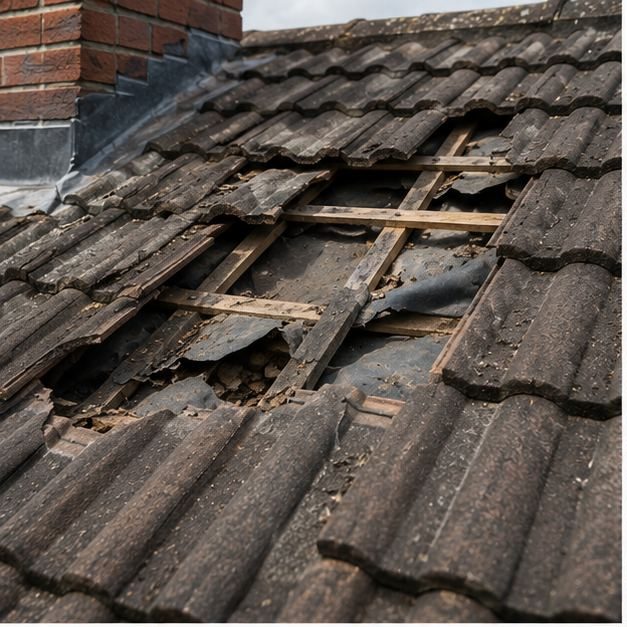
Signs a repair will do the job
A roof that is basically sound shows its trouble in small, separate places: a handful of tiles that have slipped, a cracked piece here and there, a ridge section that has lifted, or flashing that has pulled away at one chimney. If the rest of the covering sits flat and firm, and the loft is dry, patching the faults properly is usually the sensible route.
- Faults are few and clearly separated from each other
- Loft timbers are dry with no dark staining
- Tiles feel firm and are not flaking or crumbling
- Felt is intact when seen from inside the loft
Signs the roof is nearing the end
Replacement starts to make sense when the same sort of fault keeps appearing across the whole roof. Tiles that are crumbling or delaminating, nail fixings that have rusted through, and felt that has gone brittle all point that way. Repairing one area then simply moves the weak point to the next, and you pay for visits without fixing the cause.
Why the westerly exposure matters here
Roofs close to the river on the north-west side of the city take wind from the west more than most. That tends to show first at the edges, the ridge and any area where fixings have weakened. We look at which slopes face the weather, because a worn windward side with a healthy sheltered side may call for different work on each.
What we check before giving a view
We look at the roof from the ground and close up, then go into the loft. Daylight through the covering, wet or darkened timbers, and stained felt tell us where water is getting in and how long it has been doing so. Water often travels along timbers before it shows on a ceiling, so the visible stain is rarely the true source.
Questions to put to any roofer
Ask for a plain written description of what is wrong and what each option involves, repair or replace, so you can compare like with like. A good roofer will say what is urgent and what can wait, and will show you the evidence rather than just describe it. If a roofer will only offer one answer, ask why the other was ruled out.
Frequently Asked Questions
Can an older roof be partly replaced?
Often yes. If one slope has failed while the other is sound, we can re-cover the worn slope and repair the rest. The join between old and new needs careful detailing at the ridge and edges, which is why we look at the whole roof before suggesting a partial job.
Will you tell me honestly if a repair is enough?
Yes. If a repair will deal with the problem, that is what we will say, and we will explain what we found in the loft and on the roof. Replacement is only worth recommending when the fault pattern shows repairs would keep failing.
Does a leak always mean the roof needs replacing?
No. Many leaks come from a single slipped tile, a failed flashing or a blocked gutter edge. Finding the true source matters more than the age of the roof, because water can run a long way along timbers before it appears indoors.
Talk to our team about roof repairs in Shirehampton
Every roof is different — the fastest way to get an accurate answer is a quick chat with our team.