
A stain on the ceiling rarely sits beneath the hole in the roof. This is the order we work in when we trace a leak on an Easton terrace, inside and out.
Water travels before it shows itself. On a Victorian terrace it can run along a rafter or down the felt for some distance before it drops onto a ceiling. So a proper leak inspection starts indoors, works up into the loft and only then looks at the outside, following the water back to where it first got in.
Starting with the room and the stain
We begin where you noticed the damp. The shape, colour and spread of a stain tell us a lot, and so does whether it grows after rain or after a spell of cold nights. A ring that dries and returns suggests a slow leak. A sudden drip during a downpour suggests something open, such as a displaced tile or a split in a flat section.
Into the loft
In the loft we follow the stain upwards, looking at timber, felt and insulation. Dark, damp wood and wet insulation mark the path of the water. We check for daylight, for felt that has torn or sagged, and for places where the covering above no longer sits tight. This is where a leak usually gives itself away.
- Wet or stained rafters, battens and purlins
- Torn, sagging or perished felt under the tiles
- Daylight around chimneys, valleys and roof lights
- Damp insulation that has flattened or discoloured
The usual suspects on a terrace
Easton terraces have a few repeat offenders. Lead flashings where the roof meets a party wall or chimney, valleys between the main roof and a rear projection, the abutment where a lean-to meets the main wall, and the tops of bay windows. Each is a junction, and junctions fail long before the open roof slope does. Bay windows add their own lead and small flat tops, so we look at those closely on any terrace that has them.
Outside, from the ground and up close
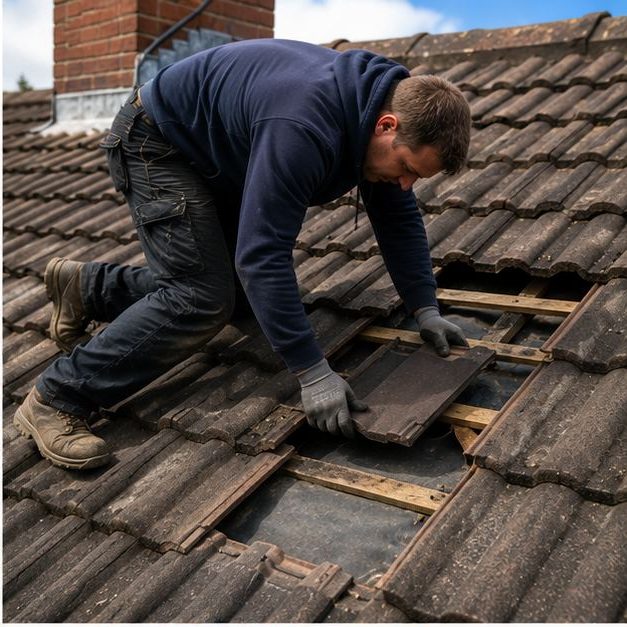
We look at the covering for slipped, cracked or missing pieces, at the ridge and hips for loose bedding, and at gutters and downpipes that may be overflowing onto the wall. Where closer inspection is needed we do it ourselves; we would not ask you to go up. If you want to check something yourself, stay on the ground and note what you see.
What you get afterwards
After the inspection we explain what is leaking, why, and what a sensible fix looks like. If the roof can be mended in a few places, we say so. If the leak points to wider failure, we say that too and describe the options. Everything is written down so you know what each repair covers. Photographs of the problem areas are part of that, so you can see what we saw rather than take our word for it.
Frequently Asked Questions
Can a leak be found without going into the loft?
Not reliably. The loft shows where the water has travelled and where it entered. Without it you are guessing from a ceiling stain, which can sit well away from the true source. If your loft is hard to reach, tell us beforehand so we can plan access.
Why does the leak only appear after heavy rain?
Often because the opening is small and only lets water through when rain is driven against it or when the roof is saturated. Wind direction matters too. We note when it happens and which wall faces the weather, because it helps narrow the search.
Should I go up and look myself?
No. Leave the roof to us. From the ground you can note stains inside, overflowing gutters and visible slipped tiles, and take photographs. That information helps us, and we will do the climbing and close checking safely.
Talk to our team about roof repairs in Easton
Every roof is different — the fastest way to get an accurate answer is a quick chat with our team.