
Traditional mortar verges look right on an older terrace but crack and fall out. Dry verge units avoid that. Here is how the two compare for the roofs you find around Easton.
On a Victorian terrace the verge is where roof meets gable, often on an end house or a rear projection. For generations it was finished with mortar. Today a dry verge is the alternative. Neither is right everywhere, so this is how we weigh them up for a roof in Easton.
How a mortar verge behaves
Mortar bedded along the roof edge is rigid, while the roof around it moves with temperature and weather. Sooner or later it cracks. Rain gets behind it, frost does the rest, and chunks fall away, leaving gaps that let weather and birds in. A well-made mortar verge can last a good while, but it is the first part of the roof to show age.
Terrace verges are often short, but they take the full force of wind and rain on exposed gables, so a failed section can let water into the roof space quickly and is worth dealing with early. A short verge is no reason to ignore a gap in it.
What a dry verge is
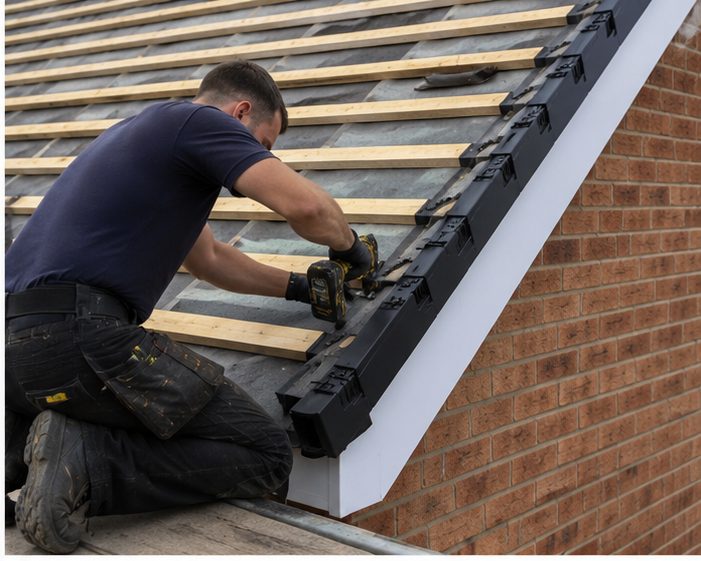
A dry verge uses mechanically fixed units and tile-end or cap pieces along the edge, so there is no wet mortar to fail. The pieces are fixed to the tile maker's guidance, and they resist wind lift at the roof edge. They also close the gap against birds and insects. Because they are fixed, not stuck, they do not crack the way mortar does.
- No mortar to crack, shrink or fall onto the path
- Fixed mechanically, helping resist wind at the edge
- Closes gaps that birds and insects exploit
- Suits new roofs, re-roofs and repairs of failed verges
Where mortar still makes sense
On an older terrace, where appearance and historic character matter, a traditional mortar verge may suit the building better, and some conservation settings expect it. Where the existing roof is in good order and the mortar is only locally damaged, a repair in matching mortar can be perfectly sensible. We do not push one system on every roof.
What decides it on your roof
Three things matter most: the tile profile, the condition of the roof edge and what you want the end result to look like. Compatibility depends on the tile, so we check on site. A dry verge is not a cure for a roof failing elsewhere, so we also look at the whole slope before suggesting either approach.
We put our findings and our recommendation in writing, including why we would choose one system over the other, so you can compare it with any other opinion you collect. That way the decision rests on evidence and not on a sales pitch.
Appearance, access and tidy work
Dry verge units come in colours to suit most roofs, and a neat finish is possible on a terrace end. Access on a busy street needs planning, including scaffold and where waste goes. Where the work forms part of larger alterations, it may need planning or Building Regulations checks — we advise before work starts.
Frequently Asked Questions
Will a dry verge look different from mortar?
Slightly. The edge is more uniform, with a clean, fixed line. Colours are chosen to match the tiles, and on most terraces the result looks tidy. We can describe the finish before you decide.
Is a dry verge always the better choice?
No. It solves a specific problem, mortar failure, and suits many roofs, but historic settings or sound mortar may favour a traditional repair. We recommend what suits the roof and the building, not a single system.
How do I know my mortar has failed?
Look for pieces on the ground, visible cracks, gaps between the tiles and the wall, or birds nesting at the edge. Please check from the ground only. If you spot any of these, call us and we will examine the verge properly.
Talk to our team about dry verge systems in Easton
Every roof is different — the fastest way to get an accurate answer is a quick chat with our team.