
Rot in a fascia board almost always starts with water that stays put. On Easton terraces the usual sources are leaking gutters, tired paint and eaves that cannot dry out.
Timber rots when it stays wet, and a fascia board is built to get wet. It sits right where roof water runs off, so the fight is not keeping rain away but letting the board dry. When something prevents that, rot usually starts at the edges and joints and works inwards, out of sight.
Gutters that leak or overflow
A gutter joint that drips onto the board, a bracket that has slipped, or a gutter that overflows over its edge will wet the same patch of fascia repeatedly. Over time that spot softens. Blocked gutters and downpipes are a frequent cause on terraces shaded by taller buildings, where moss and debris gather and nothing dries quickly.
The difference between a gutter that has simply filled with leaves and one with a failed joint is often visible as a dark streak down the wall, which we look for from the ground before we go near the board. Cleaning outlets is part of keeping any board healthy.
Paint that has failed
Painted timber relies on its coat to shed water. When paint cracks, flakes or lifts, water slips behind it and gets trapped against the timber. Cut ends and joints are the first to go. Repainting over damp wood only seals moisture in, so a sound repaint depends on drying and repairing the board first.
- Blistered or flaking paint along the lower edge
- Dark, soft patches that give under a screwdriver
- Open joints where two boards meet
- Green growth along the bottom of the board
Eaves that cannot breathe
Warm, damp air in a roof space needs a way out, and the eaves are one of the usual routes. Where soffit vents are painted over, blocked by insulation or never existed, moisture lingers and works on the rafter ends and the back of the board. Rot can start from the inside, and you only see it once the face has failed.
Older homes can have eaves detailed in ways that make airflow poor to begin with, so we look at how the roof space breathes before choosing new boards and vents. Better airflow at the eaves also helps the rest of the roof space stay dry and healthy through colder months.
Roof edge faults above
Slipped tiles, worn felt at the eaves or poor detailing at the roof edge can feed water down behind the fascia. The board then rots even though the gutter looks fine. We look at the line of roof above the fascia as well as the board itself, so we treat the real source of the water rather than just the symptom.
What we do about it
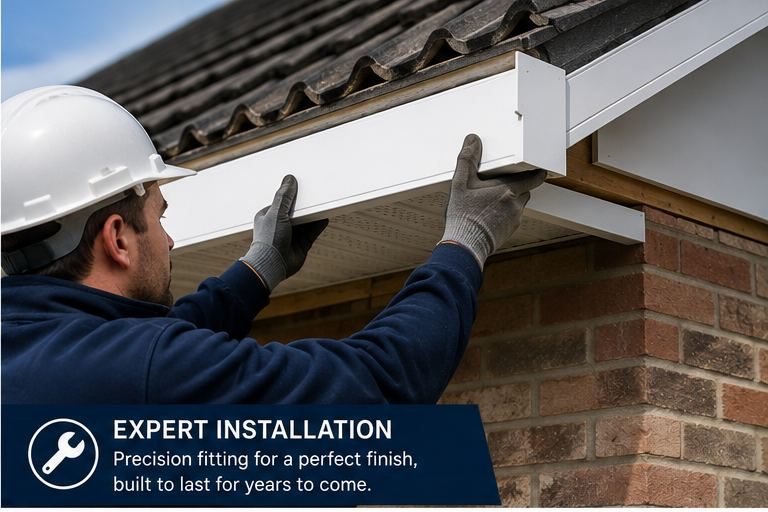
Where rot is local, a section may be cut out. Where it has spread, we replace the boards, check the rafter ends and fit new soffits, with vents or vent strips, and refit or replace the gutters. UPVC boards are cleaned rather than painted, so the maintenance cycle that caused the rot is largely gone. Scaffold or other safe access is arranged before work begins.
Frequently Asked Questions
Is rot always visible from the ground?
Not always. Paint can hold a rotten board together for some time. Signs include flaking paint, dark staining, gutters sagging, and boards that look slightly wavy. Soft wood only shows up when tested, which we do during an inspection.
Does repainting cure rot?
No. Paint protects sound timber but cannot repair decay. Painting over wet or soft wood traps moisture and speeds the failure. If the timber is firm, preparation and painting can work; if it is soft, the board needs cutting out or replacing.
Why does the same stretch keep rotting?
Usually because something above it keeps wetting it: a leaking gutter joint, a blocked downpipe or a roof-edge fault. Until that is fixed, any new board will go the same way, so we track down the source of the water first.
Talk to our team about UPVC fascias and soffits in Easton
Every roof is different — the fastest way to get an accurate answer is a quick chat with our team.