
Repairing is not always the thrifty choice, and replacing is not always necessary. Here is how we weigh up an ageing roof on Longwell Green's estates and older cottages.
The honest answer is that it depends on the roof, and anyone who says otherwise without looking is guessing. Roofs across Longwell Green range from later 20th-century estates to a few older cottages, and they age differently. What matters is how widespread the problems are. Here is how we sort one from the other.
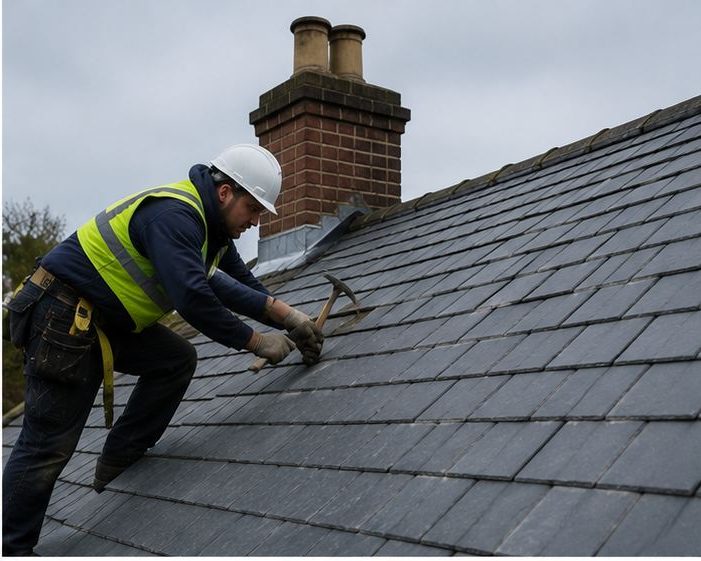
What points towards repair
A roof with a handful of slipped or cracked tiles, a worn ridge or a failed flashing is usually a repair job. If the felt and battens are sound, the covering is mostly firm and the loft is dry, fixing the specific faults makes good sense. We aim to give the repair a decent chance of lasting rather than just closing a visit. That is a plain account, and we say it just as plainly on site.
- Faults limited to a few tiles or one flashing
- Dry loft with sound timbers and felt
- Covering firm and not crumbling at the edges
- Leaks traceable to a single source
What points towards replacement
If tiles are brittle and breaking across whole slopes, the felt has perished, battens are rotten or repairs keep appearing in new places, patching becomes a poor use of effort. Each visit pays for access again while the underlying age problem remains. At that point a new covering, or a partial re-roof, is the more honest answer.
How we tell the difference
We inspect the roof from outside and the loft from inside, looking at the condition of the tiles, ridge, hips, verges and lead as well as the felt, battens and rafters. We also check how many previous repairs show, and whether they are holding up.
Then we explain what we found, with photographs where useful, so you can see the reasoning. Photographs of the loft and the roof edges are useful here, because they show the state of the felt, the battens and the rafter ends more clearly than words.
The middle road
Sometimes the best answer sits between the two. A sound slope may be repaired while a worn one is re-covered, or ridge and verge work may be done now with a larger job planned later. We tell you what is urgent, what can wait, and what would be a false economy, so you can plan around real information. Staging the work this way can keep the first outlay manageable.
Questions worth asking any roofer
Ask what the proposed work will fix, what it will not, and what you can expect in the following seasons. Ask for a written description of the work. A good roofer is happy to explain why a repair is enough or why it is not. That is how we work, and it is a reasonable thing to expect.
Frequently Asked Questions
Can I keep patching a tired roof?
You can, but each patch may only buy a short respite while other tiles fail. If repairs keep popping up in new places, a larger job is likely to be better sense than repeated call-outs. It is worth asking for photographs of what is found.
Does replacing mean stripping everything?
Not always. Some roofs need a full re-cover, others only a section. We look at each slope and the structure underneath, then explain what is actually needed. That depends on the state of the felt, the battens and the rafters underneath.
How will I know the advice is honest?
Ask to see photographs of the problems, ask what the alternative is, and ask for the work in writing. If the explanation is clear and the options are fair, that is a good sign. A fair roofer will welcome those questions.
Talk to our team about general roofing services in Longwell Green
Every roof is different — the fastest way to get an accurate answer is a quick chat with our team.