
Roofs on high, open ground tend to fail in predictable places. These are the problems we see most often around Kingsweston, and what each one usually means.
Post-war houses on the higher parts of Kingsweston and Lawrence Weston have taken decades of wind and rain with little shelter. The faults that result are fairly consistent. Knowing what they look like from the ground helps you spot them early, and helps you describe the problem when you call. Here are the ones we see most.
Slipped, cracked and missing tiles
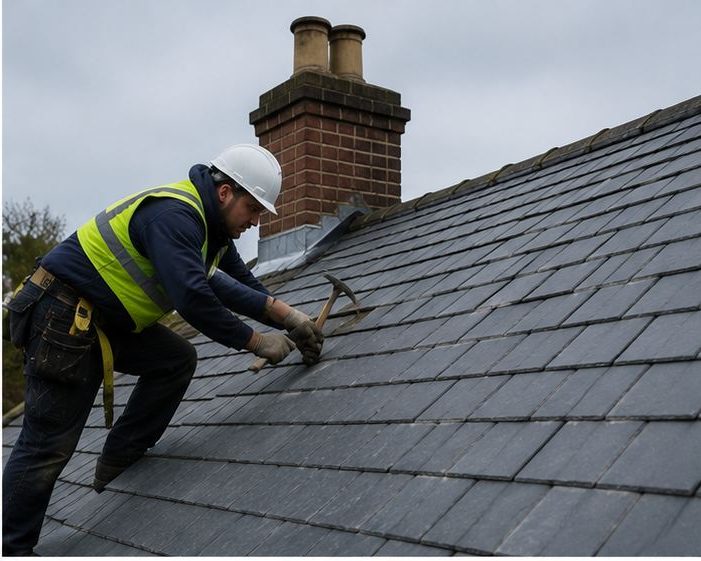
Wind gets under tiles on an exposed roof and lifts them, and old fixings let go. A slipped tile shows as a gap or a tile sitting out of line, and lets rain onto the felt beneath. These are the most common repair we deal with and usually a short job if caught before the felt and battens are affected. Spotting the gap early from the ground is half the battle.
Failed ridge and verge mortar
Mortar along the ridge and gable edges cracks as the roof moves and weather works into it. Pieces fall to the path or drive. Rebedding is the traditional fix, and a dry verge system is a longer-lasting option at the gable edge where it suits the tiles. Repointing alone may not last on a windy edge, so we explain the options when we see the roof.
- Cracked or crumbling mortar along the ridge
- Mortar pieces on paths, drives or bins
- Gaps at the gable edge of the roof
- Ridge tiles looking uneven or loose
Worn lead and flashing
Lead around chimneys, valleys and wall junctions can lift, split or pull away in wind. Water enters at these details and shows indoors somewhere else. Many leaks are traced to flashing rather than tiles, and a repair is often straightforward once the cause is confirmed. Lead that has pulled away from the brickwork is a common sign to watch for from below.
Tired flat roofs
Garage, porch and extension roofs show ponding, blisters, splits and failed edge details. Blocked outlets add to the trouble. Where the covering is still sound it can be repaired, but where it has failed widely a re-cover is the honest answer, after checking the deck beneath. Edge trims, upstands and abutments are the usual weak points, more than the middle of the covering.
Fascias, soffits and gutters
Rotten fascia boards, sagging gutters and open soffits let in water, birds and insects. They tend to be ignored until a stain shows. Replacing timber boards with UPVC, which is very low maintenance, removes the repeated painting and the rot that comes with it. A stained soffit or a green, damp fascia is worth mentioning to us when you call.
Frequently Asked Questions
Which problem is the most urgent?
Anything letting water in, such as missing tiles, split flashing or a leaking flat roof, comes first. Cosmetic wear and moss can usually wait a short while. We explain which is which when we inspect. Something brought in by wind on a high site can get worse quickly.
Can I spot these problems myself?
From the ground, yes, to a point: sagging gutters, tiles on the lawn, mortar on the path, stains in the loft. For anything on the roof itself, call us for a proper look. A torch in the loft on a wet day is a safe and useful check.
Do these faults often appear together?
Often. Wind damage at the edge, worn flashing and tired gutters tend to arrive together on an older, exposed roof, so we look at the whole roof, not just the spot that you noticed. Each fault makes the next one more likely.
Talk to our team about general roofing services in Kingsweston
Every roof is different — the fastest way to get an accurate answer is a quick chat with our team.