
A soffit closes the underside of the eaves, and a vented one lets the roof space breathe. Here is why that matters for Victorian homes in Montpelier, and how vents are worked in when boards are replaced.
Warm, damp air from kitchens, bathrooms and breathing rises into the loft. If it has nowhere to go, it condenses on cold timber and felt. A vented soffit gives that air a way out and fresh air a way in. In Montpelier's tall Victorian houses, with deep roof spaces and many flats below, that moving air does real work.
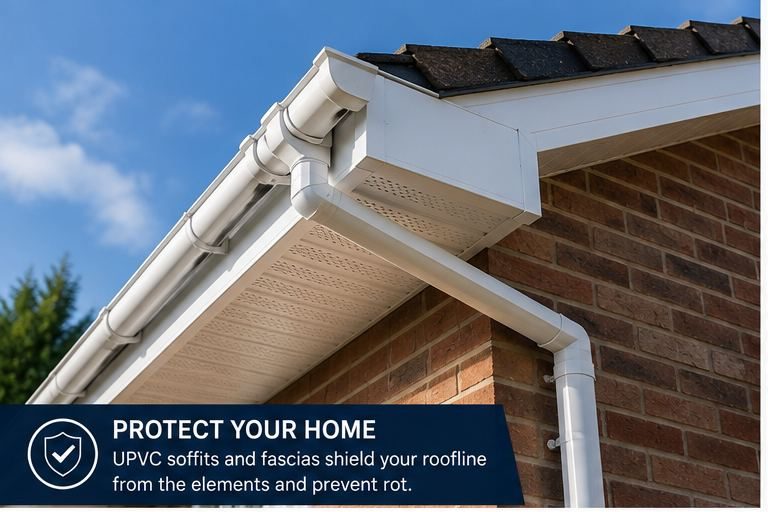
What a vent actually does
Fresh air enters at the eaves, passes up under the roof covering and leaves near the ridge or through other openings. That slow flow carries moisture away before it settles. Without it, rafters stay clammy, insulation goes damp and the underside of the felt starts to drip. A vent is not about warmth or draughts; it is about keeping timber dry.
Why older terraces are more demanding
Montpelier's Victorian terraces and villas were built when roofs leaked air through gaps. Today they have better windows, more insulation and more people living in each building, often as flats with several kitchens and bathrooms. That adds moisture while the old gaps have closed, so the roof space has less natural ventilation than it once did.
- More moisture produced in converted, multi-occupancy buildings
- Insulation laid tight against the eaves, blocking airflow
- Original gaps closed up by later repairs
- Bathroom and kitchen fans venting into the loft
What shows when a roof cannot breathe
Signs appear gradually: a musty smell in the top flat, black spotting on rafters, water droplets on the underside of the felt, rusty nails and a loft that feels damp even when the roof is sound. Often these are mistaken for a leak. Checking the eaves and how the roof is ventilated is one of the first things we look at.
How vents are fitted with new boards
When fascias and soffits are replaced, we fit vented soffit boards or vent strips set into the new boards, so air gets in without letting insects and weather through. We check rafter ends and the eaves first, make sure insulation does not block the gap, and position vents evenly along the run. On older houses we check what the existing soffit boards are made of before disturbing them.
- Old boards and gutters taken down carefully
- Rafter ends and eaves checked for damp or rot
- Vented boards or strips fitted along the run
- Insulation kept clear so air can pass
Access and tidy finish
Because of Montpelier's steep streets and tight frontages, work at the eaves usually needs scaffold, which we plan before starting. Gutters are refitted or replaced at the same time so the finished edge is square, watertight and in the finish you chose. If the ventilation looks poor but the boards are sound, we can tell you what to do about it without replacing everything.
Frequently Asked Questions
Do all soffits need vents?
Most pitched roofs benefit from some ventilation at the eaves, but how much depends on the roof, loft use and insulation. We check the roof space and recommend what suits your house instead of fitting vents everywhere by default.
Will vents let in birds and insects?
Properly made soffit vents and strips have small openings or mesh that keep out most birds and insects while allowing air through. They also need to be fitted evenly and not blocked by insulation, which we check on every job.
Can I tell from the ground if my roof is breathing?
Not fully. A musty top-floor room, condensation on loft windows or peeling paint near the eaves can hint at a problem. For a real answer, we look at the soffits from a safe position and check the loft.
Talk to our team about UPVC fascias and soffits in Montpelier
Every roof is different — the fastest way to get an accurate answer is a quick chat with our team.