
Rot in a fascia board almost always starts with water that has nowhere to go. Here are the usual causes, how to spot them from the ground, and what lasting repair involves.
Timber fascias on the estates of Bradley Stoke have been out in all weathers for a good while now, and the ones that rot rarely do so by chance. There is nearly always a cause: a leaking joint, a blocked gutter or a coating that gave up. Fixing the rot without fixing the cause only invites it back.
Gutters that leak or overflow
The most common culprit is a gutter that no longer carries water away. A loose joint, a blocked outlet or a sagging run spills water straight onto the board face and top edge. Timber that is wet again and again will soften from the inside, long before the paint shows anything wrong.
Concrete tiled roofs shed a lot of water in heavy rain, and all of it ends up at the gutter. If that channel is undersized, tilted the wrong way or full of silt, the board behind it is the first thing to suffer, and the damage builds season after season.
Water that sits on the wood
Rot needs moisture that stays put. Fascias hold water where the board meets the soffit, along the bottom edge and at open joints. Splits and ends of boards soak it up like a wick. Once timber stays damp, fungal decay begins, which is why a spongy patch under flaking paint is usually a sign the damage is well advanced.
Paint and age
Paint seals timber only while it is intact. Cracks and peeling let water in, and then the coating traps it there. Repainting over damp wood makes things worse. Where boards were put up with little preparation, the end grain and cut edges can start to fail first, often unseen above the gutter line.
Checking whether the wood is soft is a job for us, not for you on a ladder. From the ground, look for dark streaks, bubbling paint and any board edge that looks darker or swollen compared with its neighbours along the same roofline.
- Paint that blisters or peels in patches
- Dark, damp-looking stripes below the gutter
- Gaps opening at board joints
- Moss or green growth along the board edge
Poor ventilation at the eaves
If the roof space cannot breathe, warm damp air from the house condenses on timbers at the eaves. Blocked or missing vents let that moisture sit. Replacement boards with vented soffits or vent strips let air move, which helps keep rafter ends and the new boards dry.
Even sound boards suffer if air cannot move behind them, so replacing the soffit and its vents at the same time as the fascia is usually worth doing. It costs little extra effort while the scaffold is up and the old boards are already off.
Repair, replace or switch material
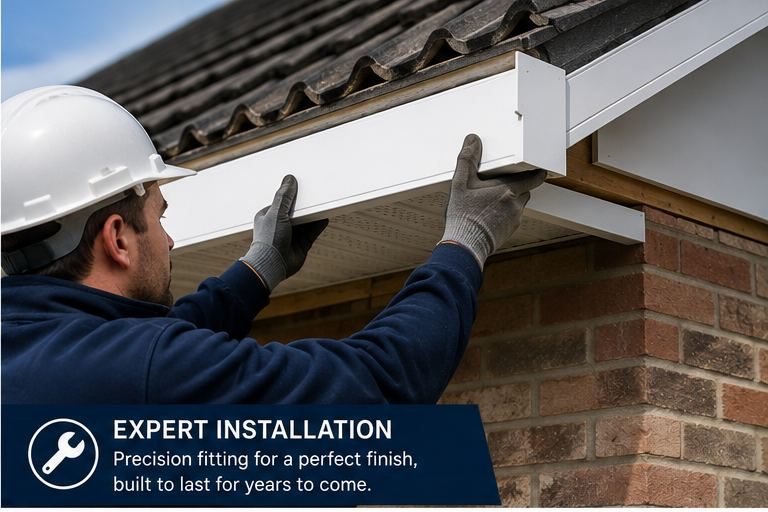
Small, local rot can be cut out if the rafter ends behind are sound. Widespread decay calls for new boards, and many owners choose UPVC, which is cleaned rather than painted and is very low maintenance. In white, darker colours or wood effect. If any work may need planning or Building Regulations checks, we advise before work starts.
- Check rafter ends before covering them
- Replace failed gutters at the same time
- Use vented soffits or vent strips
- Plan safe access or scaffold first
Frequently Asked Questions
How can I tell if my fascia is rotten from the ground?
Look for peeling or bubbling paint, dark staining, sagging gutters and gaps at the joints. Soft, crumbling timber confirms it, but testing it means getting up high, so ask us to check rather than climbing up yourself.
Will painting over the rot stop it?
No. Paint over damp or decayed wood hides the problem and traps moisture, so the rot carries on underneath. The damaged timber needs cutting out or the board replacing, and the source of the water needs fixing first.
Does rot in the fascia spread to the roof?
It can. Damp from the board can reach the rafter ends, the underlay and the eaves timbers. That is why we always check what is behind a rotten board before deciding between repair and replacement.
Talk to our team about UPVC fascias and soffits in Bradley Stoke
Every roof is different — the fastest way to get an accurate answer is a quick chat with our team.