
Three parts of the roof edge get lumped together, yet each does a different job. Here is a plain guide to fascias, soffits and gutters on St Pauls terraces, converted houses and flats.
Stand in front of a Victorian terrace and look up at the edge of the roof, and you are seeing three separate parts working together. Knowing which is which makes it much easier to understand a quote, spot a problem early and decide what actually needs replacing on a house in St Pauls.
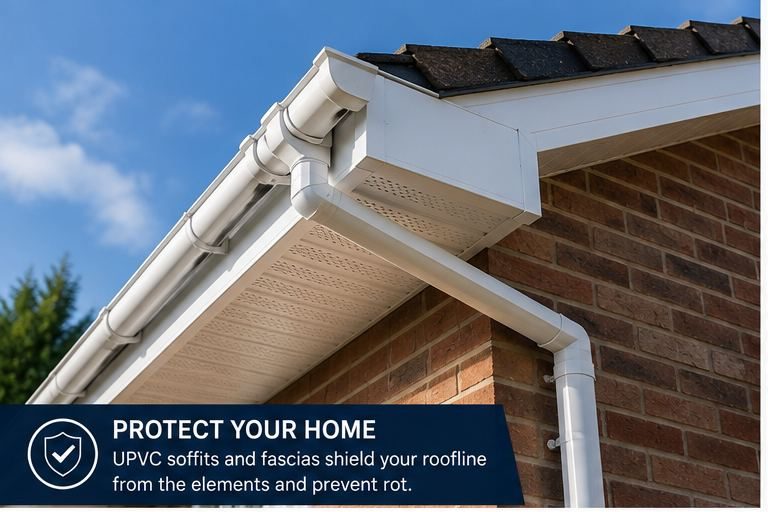
The fascia
The fascia is the board running along the ends of the rafters, facing outwards. It carries the gutter and gives the roof edge a finished line. Because the gutter hangs from it, a rotten or loose fascia often shows first as a sagging gutter or water overflowing behind it, rather than as a problem with the board itself.
On terraces with parapets or shared eaves, the roof edge can look different from house to house, so we look at how your own run is built and where the water from neighbouring roofs ends up before suggesting anything. That is the kind of detail a written description should cover.
The soffit
The soffit is the board that closes the underside of the eaves, between the wall and the fascia. It keeps birds, insects and weather out of the roof space. A vented soffit, or a vent strip, also lets air move through the roof so the timbers and insulation stay dry and the loft does not turn damp.
A soffit with no ventilation can trap moist air in the roof space. That is worth knowing in flats and converted houses where loft space is limited, because condensation there often gets blamed on a leak. Good ventilation at the eaves is a simple way to prevent it.
The guttering and downpipes
The gutter catches rain from the roof and the downpipe carries it to the drain. It is fixed to the fascia or to brackets on the rafters. A gutter that leaks at joints, is blocked or has dropped out of line sends water down the wall and onto the fascia, which is why the three parts fail together.
- Joints that drip or have split
- Brackets that have loosened or rusted
- Outlets blocked by leaves and moss
- Gutters that no longer fall towards the downpipe
Why they matter on older terraces and flats
On tightly packed streets, roof edges are close to neighbours and often hard to reach, so faults go unnoticed. Replacement needs proper access, usually scaffolding, and we check the rafter ends and eaves once the old boards are off. On older homes we check what the existing soffit boards are made of before disturbing them.
What replacement looks like
Old boards and gutters come off, the rafter ends and eaves are checked and repaired if needed, then new boards, ventilated soffits and gutters go on. UPVC is very low maintenance and is cleaned rather than painted. It comes in white and in darker and wood-effect finishes, so it can suit the look of the house.
- Removal of old boards, gutters and downpipes
- Checking rafter ends for rot
- New fascia and soffit boards with ventilation
- Gutters and downpipes refitted or replaced
Frequently Asked Questions
Do fascias and soffits always get replaced together?
Not always, but they are usually done together because they share the same access and the same cause of failure. If only one is damaged we say so, though doing both avoids paying for access twice.
Can I replace just the guttering?
Yes, when the gutter is the only thing failing and the fascia behind it is sound. We check the board before fitting anything, because a new gutter on a rotten fascia will not stay up.
How can I tell if my soffit needs attention?
From the ground, look for peeling paint, sagging or stained boards, gaps where birds get in, or green growth along the eaves. These suggest water has been getting in, and we can inspect it properly.
Talk to our team about UPVC fascias and soffits in St Pauls
Every roof is different — the fastest way to get an accurate answer is a quick chat with our team.