
Not every leaking flat roof needs ripping off. The answer depends on how widespread the damage is and what lies under the covering, and in St Pauls that often means extensions to older terraces.
Flat roofs in central Bristol tend to sit on rear extensions, outbuildings and bay tops attached to older terraced houses, where space is tight and drainage is awkward. Whether to repair or replace comes down to the condition of the covering, the deck beneath and how far the trouble has spread.
When a repair makes sense
If the covering is mostly sound and the fault is local, a repair is the sensible choice. A single split, a lifted seam, a failed joint at a wall or a patch around an outlet can be cut out and renewed without disturbing the rest of the roof.
Repairs work best when the leak is caught early, before water has had time to soak the boards underneath. Prompt attention often saves a bigger job. We would rather tell you honestly that a small repair will do than sell more work than the roof needs.
When replacement is the honest answer
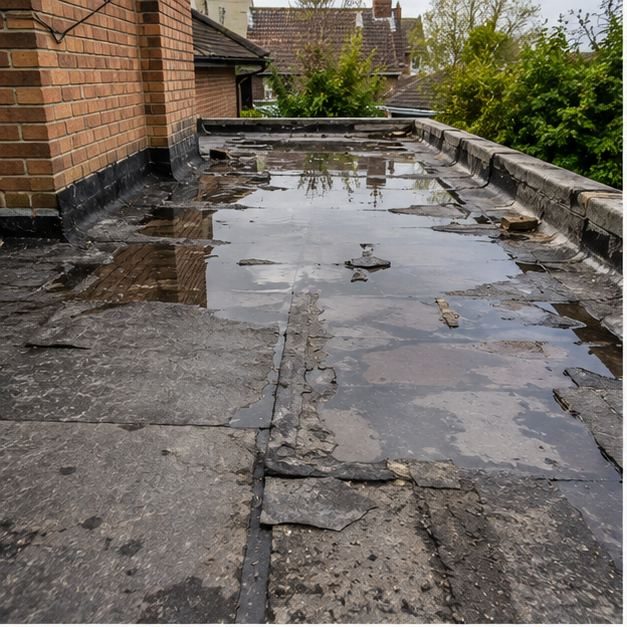
If the surface is cracked or blistered in many places, repairs keep reopening, or water has been sitting on the roof for a long time, patching only delays the problem. A replacement gives a clean, consistent covering with proper falls so water drains away instead of lying in pools.
- Cracking or splitting across large areas
- Soft or spongy boards under the covering
- Repeated leaks in different places
- Standing water that never clears
What we check before deciding
We look at the covering, the edges and upstands, the outlets and the underside from inside where we can. Pressing on the surface tells us if the deck is firm. We also look for stained ceilings and damp timbers, because the deck is what decides whether a repair is worth doing.
Where the roof is a small extension or porch, access is usually simple from the rear, but we arrange it properly beforehand. Then we explain in plain terms what we found and what each route would involve. That helps us plan. Nothing is hidden from you.
Why the deck matters
The covering is only as good as what it sits on. Where water has been getting in for a while, boards rot, and a new membrane laid over weak boards will fail early. If the deck is bad we cut it out and renew it, and we fit insulation and falls at the same time, since the roof is already open.
Getting a straight answer
Ask for the reasoning in writing: what is wrong, whether it is repair or replacement, and what each option involves. A fair roofer will not push replacement when a repair will do, and will not patch a roof that is clearly finished.
- A written description of the proposed work
- Which covering is proposed and why it suits the roof
- What happens if the deck is found to be rotten
Frequently Asked Questions
How can I tell if my flat roof is beyond repair?
Widespread cracking, blistering, repeated leaks and soft boards are the usual signs. A ceiling stain that keeps returning after repairs is another. From the ground you may see standing water or sagging, and we confirm the rest on a proper inspection.
Can a new layer go over the old covering?
Sometimes, but not always. If the old covering is wet, blistered or hiding a weak deck, covering it just traps the problem. We check what is underneath and advise on whether to strip back or build over.
What coverings are used on a replacement?
Common choices include single-ply rubber such as EPDM, fibreglass or GRP, and felt systems. The right one depends on the shape of the roof, the details at the edges and how it is used, and we explain the reasons for the choice.
Talk to our team about flat roofing in St Pauls
Every roof is different — the fastest way to get an accurate answer is a quick chat with our team.