
Timber fascias on exposed Hotwells terraces take a beating from wind and rain. Here is how to tell when painting is no longer enough and replacement with UPVC makes sense.
Fascia boards sit at the very edge of the roof, carrying the gutter and taking whatever the weather throws. In Hotwells, with exposed slopes on the gorge side, tall terraces and steep streets that make access difficult, timber boards can age quickly and are expensive in effort to repaint. Knowing when to stop patching helps you plan the work.
Signs that timber has had its day
Press gently on a board from a safe position, or look for obvious signs from the ground: flaking paint, cracks along the grain, dark patches, gaps at joints and gutters that sag. If the wood looks spongy or breaks away, the damage runs deeper than the paint. Green growth along the bottom edge and stains down the wall below the gutter point to water spilling over or soaking in behind the board.
- Flaking paint that returns after repainting
- Cracks or splits running along the grain
- Gutters sagging between brackets in the roof space
- Open joints at corners and board ends
- Staining on the wall below the roofline
The cost of staying with timber
Timber needs repainting, and each time that means access: scaffolding or a tower on a steep street, with all the arrangements that brings. When boards are high on a terrace, the access can be the main effort. That is a big reason people move to UPVC. If the timber is basically sound, a good repaint may be sensible for now. We say so when that is the honest answer.
What replacement achieves
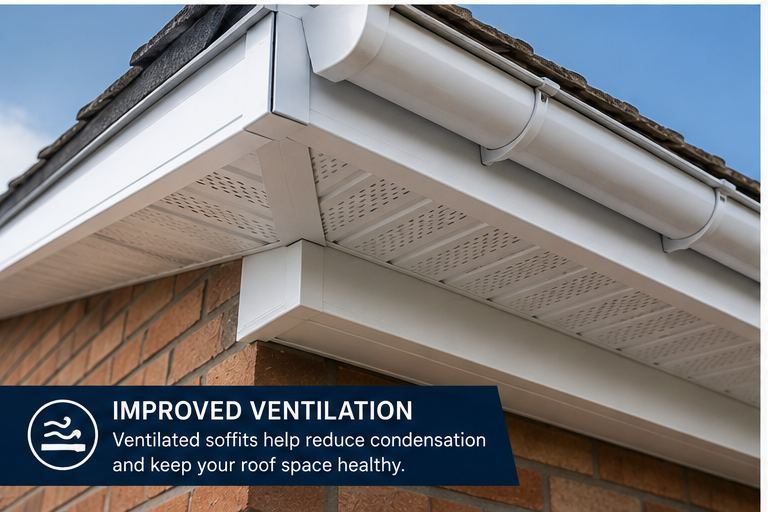
UPVC boards do not rot, and are cleaned, not painted, so they are very low maintenance. They come in white and in darker and wood-effect finishes, which can suit Georgian and Victorian frontages as well as the modern flats nearby. Fresh boards also give a good chance to check the eaves, fit vented soffits and renew tired gutters in one go, with access already in place.
What we check on older roofs
Before removing anything, we look at the rafter ends, the wall plate and the fixings. Hidden rot at the back of a board is common where water has been running behind it for some time, and it needs repairing before anything new goes on. On older houses we check what the existing soffit boards are made of before disturbing them. We handle that calmly and explain what we find.
Picking the moment
Good times to replace are when boards are failing, when the gutters need renewing, or when scaffolding is already up for other roof work. Exposed slopes also make sense to deal with before a hard winter instead of after. Replacement on some period buildings may need planning or Building Regulations checks — we advise before work starts.
Frequently Asked Questions
Can I just repaint the boards again?
If the timber is firm all the way through, yes, and we will say so. If it is soft or cracked, paint only hides the damage. We press and inspect the boards before advising either way.
Will UPVC suit an older terrace?
Often, with the right finish and profile. White suits many Georgian and Victorian terraces, and wood-effect or darker finishes are available. We talk through the look with you and check the existing detail before choosing. We explain this on site.
Do soffits need replacing too?
They often do, because the same water that rots the fascia reaches the soffit. We check them and the ventilation. Vented soffits or vent strips keep the roof space breathing, which protects the timbers above. We explain this on site.
Talk to our team about UPVC fascias and soffits in Hotwells
Every roof is different — the fastest way to get an accurate answer is a quick chat with our team.