
Wind pulls hardest at the roof edge, and mortar there is the weakest link. A dry verge fixes the edge mechanically, which gives tiles and verge pieces a better hold in a gale.
Wind does not push a roof so much as lift it, and the edge at a gable takes the worst of it. In Cotham, tall houses stand up above their neighbours and catch gusts from several directions. The verge is where a roof tends to start to lose tiles, so how it is fixed matters.
Why the verge is the weak spot
At a gable, air flows over and around the roof edge and creates strong uplift. Tiles along that line have nothing beside them to share the load. If they are held only by a bed of mortar, a few gusts can crack the bed, loosen a tile and let the wind get underneath. Then the next gust finds an easier job. The edge of a tall gable gets the strongest gusts of the whole roof.
What a dry verge changes
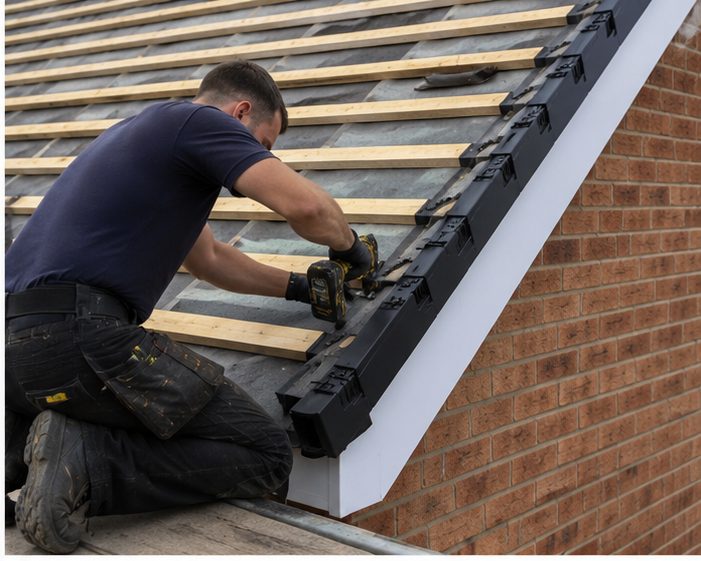
Dry verge units are fixed with mechanical fasteners, not stuck on with a bed of mortar. The verge pieces and tile-end units are held positively to the roof structure, and there is no mortar to crack or fall out. That gives the edge a firmer grip in wind, and it does not depend on a bond that weakens with age. It also keeps working when the mortar would have dried out and cracked.
Fixed to the tile maker's guidance
Done properly, the units and fixings follow the guidance for the tile in use. That is why compatibility depends on the tile profile and is checked on site rather than assumed. Using the right fixings and the right spacing is what gives a dry verge its strength. A loose, improvised fixing would defeat the purpose. What we check when advising on a verge:
- The tile type and profile on the roof
- The condition of the battens and rafters at the edge
- Whether the existing mortar has failed or tiles have moved
- The exposure of the gable
What it will not do
A dry verge is not a cure for a roof that is failing elsewhere. It improves the edge, not slipped tiles in the middle, a tired covering or worn felt. If wind has already damaged the roof, we repair that first or alongside, and we give you a straight view of what the whole roof needs.
Signs your verge is struggling
From the ground, watch for mortar falling onto paths, a visible gap or crack along the gable edge, or tiles at the end of a run that look out of line after a storm. These are early signs. Please do not go up to check; call us for a proper look and we will explain what we see.
Frequently Asked Questions
Is a dry verge stronger than a mortar verge?
For wind resistance at the edge, it is generally the better choice because it relies on mechanical fixing rather than a bond that can crack. Its effectiveness still depends on correct fitting and compatible tiles.
Will it make my whole roof wind-proof?
No. It strengthens the edge, which is where much wind damage starts. The rest of the roof still needs to be sound, with tiles, felt and fixings in good order. A sound roof and a sound edge work together.
Can a dry verge be fitted to my existing roof?
Often yes, especially where the old mortar has failed, but it depends on the tile profile. We check on site whether the units are compatible and tell you plainly if they are not. It is a repair or upgrade that suits many roofs where the mortar has failed.
Talk to our team about dry verge systems in Cotham
Every roof is different — the fastest way to get an accurate answer is a quick chat with our team.