
The verge is where wind gets its first grip on a gable. A dry verge fixes the edge mechanically, which is why it resists gusts better than mortar that has aged and cracked.
Wind pushes hardest on a roof at its edges, and the gable end is an obvious weak point. In east Bristol's mix of terraces and inter-war houses, plenty of verges are still bedded in old mortar. When that mortar goes, tiles at the edge become loose. A dry verge tackles that directly.
Why the edge takes the punishment
Wind that hits a gable wall splits and rushes up and over the roof, lifting at the edge. The tiles right at the verge are the least held in by their neighbours. If the mortar beneath them has cracked, one gust can pull a tile free, and then the next row loses its support too. Gable ends on terraced rows are often the most exposed part of the roof, so it pays to keep that edge secure.
How a dry verge holds the edge
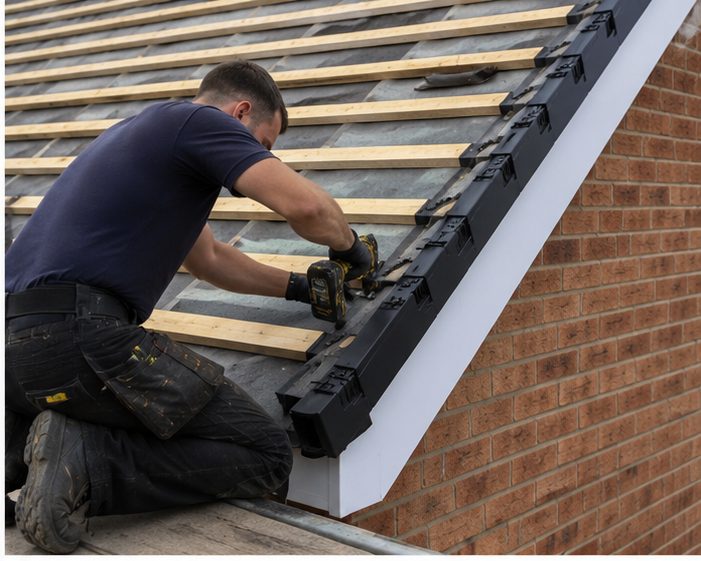
Instead of relying on mortar to grip, dry verge units are fixed mechanically to the roof structure. Tile-end and cap pieces lock the final tiles down at the edge. There is no wet bed to crack, shrink or wash out, so the grip does not weaken as the seasons pass. We fit it to the tile maker's guidance.
- Mechanical fixings hold the edge, not mortar.
- Fewer loose pieces to fall onto paths or drives.
- The edge is covered and shielded from rain.
- Suits new roofs, re-roofs and repairs.
What it cannot cure
A dry verge does not make a failing roof wind-proof. If tiles across the slope are slipping, nails have corroded or the battens are poor, wind will find those weak points. The verge is one part of the system. We look at the whole roof and tell you whether the edge alone is the problem or a symptom of a wider fault.
Fitting depends on the tile
Not every tile profile takes every verge unit. We check the style of tile on your roof, the condition of the battens and the shape of the gable before suggesting a system. Where a dry verge is a good fit, we remove the old mortar, make good the edge and fit the units neatly. Where it is not, we say so and explain alternatives.
- The tile profile decides which units fit.
- Weak battens at the edge are put right first.
- Cracked or broken tiles are replaced.
- Old mortar is cleared before fitting.
Signs your verge may be struggling
Check from the ground after a blow. Small chunks of mortar on the drive, a tile sitting slightly out of line at the gable, or a visible gap along the edge are early warnings. You do not need to get close, and you should not go up to look. Tell us what you can see and we will inspect it safely. If you are unsure what you are seeing, a photo from the pavement is a good start.
Frequently Asked Questions
Will a dry verge make my roof storm-proof?
No roof is storm-proof. A dry verge strengthens one vulnerable part, the edge, and removes mortar that can fail. Wind can still damage other areas, so the rest of the roof still needs to be sound.
Is a dry verge only for new roofs?
No. It suits new roofs, re-roofs and repairs where the mortar has failed. On an existing roof we first check that the tiles and battens at the edge are sound enough to take the units.
What if only one verge is damaged?
We can often repair or replace just the affected side. If both sides are ageing, it can make sense to do the pair together while access is in place. We look and give an honest view.
Talk to our team about dry verge systems in Greenbank
Every roof is different — the fastest way to get an accurate answer is a quick chat with our team.