
Covering old timber with plastic is quicker, but it also covers whatever is going wrong beneath it. Here is why we usually strip back to the rafter ends first on Greenbank's older houses.
The short answer is that it can be done, but it is rarely the best route. Fitting new UPVC straight over old boards looks neat at first. The trouble is that you cannot see what is behind it. On the older Greenbank terraces, with timber that may have been there a long time, we prefer to look first.
Why people ask the question
It sounds simpler and quicker. Leave the old boards in place, cap them with new white or wood-effect UPVC, and the job is done in less time with less mess. For a board that is still straight, solid and dry, there is a case to be made. The problem is that you rarely know that without taking a look.
What goes wrong when you cover timber
Rot starts where water sits. If damp is already in the board or in the rafter ends behind it, sealing it under plastic traps the moisture and the decay carries on out of sight. Fixings also need something sound to bite into. A soft, crumbling board will not hold a new one firmly, and gutters hung from it can sag.
- Hidden rot continues behind the new boards.
- Fixings pull out of soft or crumbling timber.
- Boards that are bowed or uneven show through the cladding.
- Gutters sit out of line and drain badly.
What we check first
Before deciding we look at the whole eaves: the fascia, soffit, rafter ends, and how the gutters are held. A screwdriver tap on suspect timber tells us how sound it is. If the boards are sound and flat we say so; if there is rot or movement we explain what we found and what we recommend instead.
What replacement normally involves
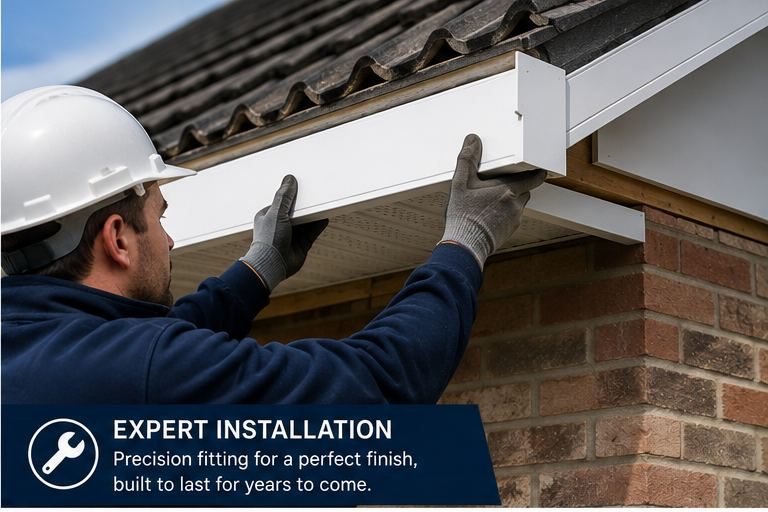
For most jobs we take the old boards and gutters off, check the rafter ends and eaves, treat or repair what we find, then fit new fascias and soffits. Vented soffits or vent strips go in so the roof space breathes, and the gutters are refitted or replaced. Scaffold is needed for safe access. On older homes we check what existing soffit boards are made of before disturbing them.
Finish and upkeep
New UPVC is very low maintenance. It is cleaned with a cloth and mild soapy water rather than painted, which is a relief after years of repainting timber. White is the usual choice on terraced rows, though darker colours and wood-effect finishes are available if you want a different look. Ask us to show you how the corners and joints will be finished.
- Wipe down occasionally with warm soapy water.
- No scraping, sanding or repainting cycle.
- Choose white, a darker shade or wood-effect.
- Check gutters and joints after storms.
Frequently Asked Questions
Does covering over save trouble in the long run?
Not if it hides rot. Fixing a problem you can see is easier than finding one that has spread. Covering sound boards can work, but we would want to inspect them before agreeing to it.
What if only part of the fascia is rotten?
Then we may cut out and replace the bad length and renew the rafter ends where needed. Often, though, damp has spread further than it looks, so we check the wider run before deciding on a partial job.
Do you need scaffolding for fascias?
Yes, in nearly all cases. It lets us work at the eaves safely and properly, removing boards and gutters and checking behind them. We arrange it as part of the job and talk it through with you beforehand.
Talk to our team about UPVC fascias and soffits in Greenbank
Every roof is different — the fastest way to get an accurate answer is a quick chat with our team.