
Traditional mortar and modern dry verge units both close the edge of a gable roof. Here is how they differ and which suits buildings in Old Market.
Mortar has finished roof edges for generations, and plenty of verges in Old Market still rely on it. A dry verge does the same job with fixed pieces instead. Neither is right everywhere, so the honest answer depends on what is on your gable and on how it has been behaving.
How mortar behaves at the edge
Wet mortar bedding looks neat and traditional, and on a sheltered, well-built verge it can last well. The weakness is that mortar cracks as the building moves and the weather works on it. Once it loosens, water gets in, and pieces drop onto paths, drives and passers-by below.
Terraces that share walls move differently from detached buildings, and the gable edge on an end-of-terrace takes more weather than the rest of the roof. That exposed corner is typically where mortar gives up first, and where a repair is most noticed from the street.
How a dry verge works
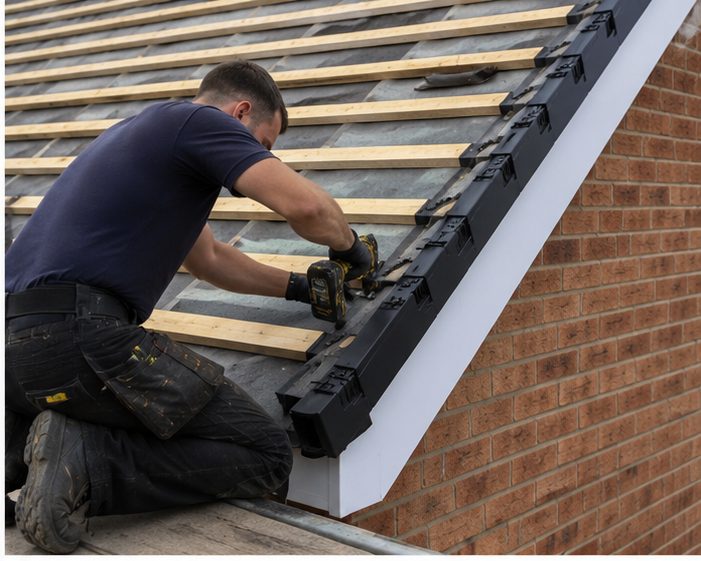
A dry verge uses mechanically fixed units and tile-end or cap pieces, so no wet mortar is involved. The edge is held against wind by fixings rather than by a bed of cement. It also keeps weather, birds and insects out, and removes the part of the verge most likely to fail.
Where mortar still makes sense
On a conservation-minded older building, a traditionally bedded verge may suit the look better, and a sound existing verge does not always need replacing. If it is intact and tight, we will say so. The question is whether it is holding or slowly letting go, which is often visible from the ground.
Where a dry verge pulls ahead
New roofs, re-roofs and repairs where mortar has already failed all suit a dry verge well. Exposed gables on taller buildings, where wind lifts at the edge, benefit most from a fixed system. Compatibility depends on the tile profile, which we check on site before recommending it.
- Mortar crumbling or falling onto paths below.
- Gaps along the edge where light or birds get in.
- Tiles at the gable loose or leaning.
- A re-roof where the whole edge is being redone.
Making the decision with a roofer
Ask for the reasoning, not just a price. A fair adviser will look at the edge close up, note the condition of the wall top and the roof behind, and tell you which option fits. A dry verge will not cure a roof failing elsewhere, and we say so when that applies.
Whichever way it goes, the work should be explained before it starts: what comes off, what goes on, and how the edge is held. You should also be told how the pavement, passers-by and neighbours are looked after while we work.
Frequently Asked Questions
Is a dry verge always the better choice?
Not always. On a sound, traditionally finished verge there may be no need to change anything at all. A dry verge tends to win where mortar has failed, where the edge is exposed to strong wind, or where the roof is being renewed anyway, and we explain which case yours is.
What is the first sign that mortar is failing?
Crumbs and lumps of mortar on paths, drives or in gutters are the typical first sign. You may also see gaps along the edge or tiles that look loose. These can be spotted from the ground, without going near the roof.
Will a dry verge look very different?
Units are made to follow the tile line and come in finishes that blend with common coverings, so the edge looks tidy and consistent along its length. We can talk through the look beforehand, taking account of the tiles already on the roof and the neighbouring buildings.
Talk to our team about dry verge systems in Old Market
Every roof is different — the fastest way to get an accurate answer is a quick chat with our team.