
Mortar at the edge of a gable looks neat on day one and starts failing soon after. A dry verge swaps it for fixed units, and here is exactly how that works.
If you have noticed bits of mortar on the path beside a gable wall, you have seen the weakness of a traditional verge. Houses across Henleaze have plenty of gable ends, from semis to larger detached homes. A dry verge system removes the wet mortar altogether. This guide explains the parts, how they hold, and what they do for the roof.
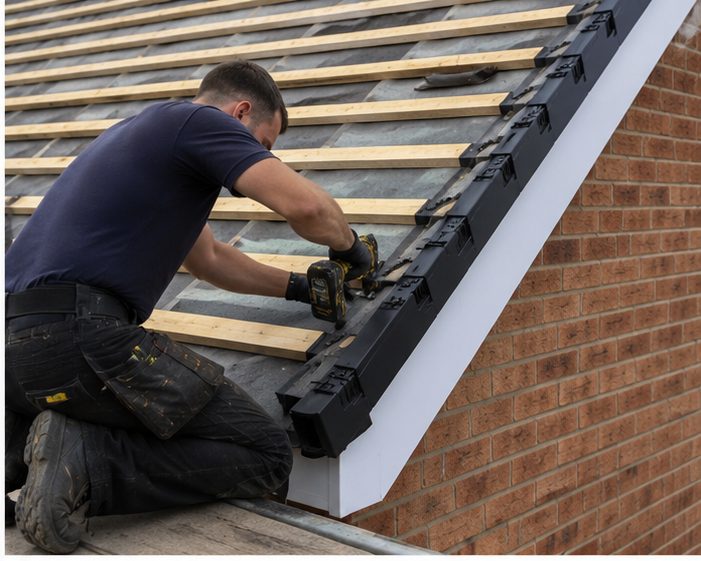
What a verge is
The verge is the edge of the roof at a gable, where tiles stop at the wall. Traditionally the tiles were bedded onto a strip of mortar along the top of the wall, with pointing to finish. It looks solid, but mortar shrinks, cracks and washes out under repeated wetting and drying, and that opens the edge to wind and rain. It is a simple idea, and the simplicity is the point.
What a dry verge is made of
A dry verge uses factory-made verge units, usually plastic or similar, that run along the edge and are screwed or clipped to the roof structure. Matching tile-end and cap pieces finish each course, and ridge ends are capped to suit. There is no wet mortar anywhere in the system, so nothing is left to crumble. Everything is cut and fitted to the roof in front of us.
- Continuous verge units fixed along the edge
- Tile-end pieces matching each course
- Ridge-end caps to finish the top
- Fixings set out to the tile maker's guidance
How it protects the edge
The fixings tie the edge tiles down, which gives better resistance to wind lifting at the most exposed part of the roof. With no mortar to fall out, there is no gap for rain, birds or insects to use. On wooded Henleaze streets, where leaves and debris collect at edges, a sealed, tidy verge is also easier to keep clear. That is a practical gain on a tree-lined street.
Where it is used
Dry verges are standard on new roofs and re-roofs, and they suit repairs where the old mortar has failed. Compatibility depends on the tile profile, which we check on site. It protects the edge only; a roof failing elsewhere still needs attention. Where work may need planning or Building Regulations checks, we advise before work starts.
What to look for in a proposal
Ask which units will be used with your tile type, how they are fixed, and whether the work follows the tile maker's guidance. A written description should say what happens at ridge ends and corners. If a roofer cannot explain how the edge is held without mortar, ask again. Clear answers here are a good sign of careful work.
Frequently Asked Questions
Is a dry verge as strong as mortar?
In practice it is more reliable at the edge, because the tiles are mechanically fixed rather than relying on a bed of mortar that cracks. Strength depends on correct fixing, so the method follows the tile maker's guidance. so the tile edge stays put in gusts.
Can mortar still be used anywhere with a dry verge?
The verge itself needs no wet mortar. Other parts of a roof, such as some hips or chimney details, may still use it, and we explain what is used where when we describe the work. It is a mortar-free finish at the edge.
How will I know my verge is failing?
Look for mortar fragments on paths or drives, cracked pointing, tiles sitting out of line at the gable, or green staining. These signs are visible from the ground. Photograph them and call us for a proper look.
Talk to our team about dry verge systems in Henleaze
Every roof is different — the fastest way to get an accurate answer is a quick chat with our team.