
Wind and driving rain find the weak points in a roof fast. Here is what to check from the ground after a storm, what to record, and what happens when we come out to look.
After a storm the first job is to stay off the roof and work out what has actually happened. In Barton Hill the mix of Victorian terraces, later council-built houses and blocks, and plenty of flat-roofed extensions means damage shows up in different ways. Start with a walk round at ground level, then look inside the loft or top-floor rooms.
Check from the ground first
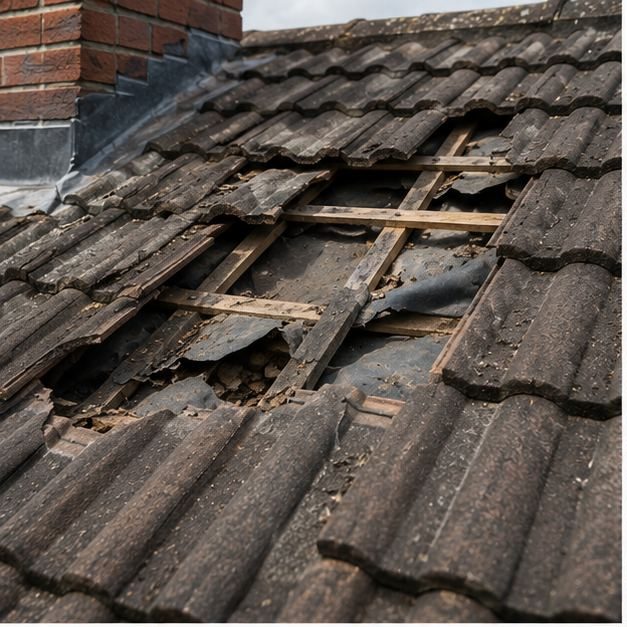
Look up from the pavement, the yard or the garden, with binoculars if you have a pair. You are looking for tiles out of line, gaps in a course, ridge pieces that have shifted and gutters hanging at an angle. Never climb up for a better view. Anything you can see from the ground is enough to describe to us.
- Pieces of tile or slate on paths, drives or in the garden
- Gutters sagging or pulled away from the wall
- Lead or flashing lifted around a chimney or wall
- Covering lifted at the edges of a flat extension roof
Look inside for water
Go into the loft if there is a safe, fixed way up, or check the top-floor ceilings and walls. Daylight through the roof, dark patches on timbers and wet insulation all point to a breach. Water often runs along a rafter before it drips, so the stain may sit well away from the hole. Move belongings clear and catch drips in a bowl.
If water is coming through a light fitting or the ceiling is visibly bowing, keep the room clear, switch off the circuit if it is safe to do so, and call us straight away. Do not poke or drill the ceiling to let the water out.
Record what you find
Take photographs from the ground of anything that looks wrong, and note roughly when the storm hit. Pictures of fallen pieces where they landed are useful too. This helps us understand the damage before we arrive, and it is handy for your own records or if you are making a claim.
Do not throw away broken tiles or slate that have landed in the yard or garden. They tell us what the roof is made of and whether matching pieces are needed, so we can arrive with the right materials and avoid a second visit just to fetch them.
What we do when we arrive
We look at the whole roof, not just the obvious gap, because one lifted tile often means its neighbours are loose too. If water is getting in we make it safe first, then explain the repair: replacing tiles, re-bedding ridge pieces, refixing flashing or sorting a gutter. On flat extensions we check edges, joints and any areas where the covering has lifted.
What is urgent and what can wait
Open gaps, loose ridge pieces and anything that could fall onto a path need attention soon, because the next gust will make them worse. A small slipped tile with a dry loft is less pressing, though it still should not be left for long. We tell you plainly which is which, so you are not paying for work that can wait.
Frequently Asked Questions
Can I put a slipped tile back myself?
No. Roofs are slippery and a fall can be serious, and a tile pushed back without checking the fixings often slides again. Photograph it from the ground and call us. We will fix it and check the surrounding area at the same time.
My ceiling is stained but the roof looks fine. Why?
Water travels along timbers and under felt before it shows, so the entry point can be some distance from the stain. Gaps around flashing, a cracked tile or a blocked gutter can all be the source. We trace it from the loft and the outside.
Is a leak after a storm always a roof problem?
Not always. Overflowing gutters, a failed flat roof joint or a cracked chimney flashing can all let water in after heavy rain. That is why we look at the whole roof and its drainage rather than just the area under the stain.
Talk to our team about roof repairs in Barton Hill
Every roof is different — the fastest way to get an accurate answer is a quick chat with our team.