
Easton's Victorian terraces share a short list of roofing problems. Most are at junctions and edges rather than the main slope, which is where we look first.
Walk along a row of Victorian terraces and the same roof faults keep turning up. Age is part of it, and so are the additions: bay windows, rear lean-tos and small flat roofs that were added to the original house. The trouble tends to gather where one part of the roof meets another.
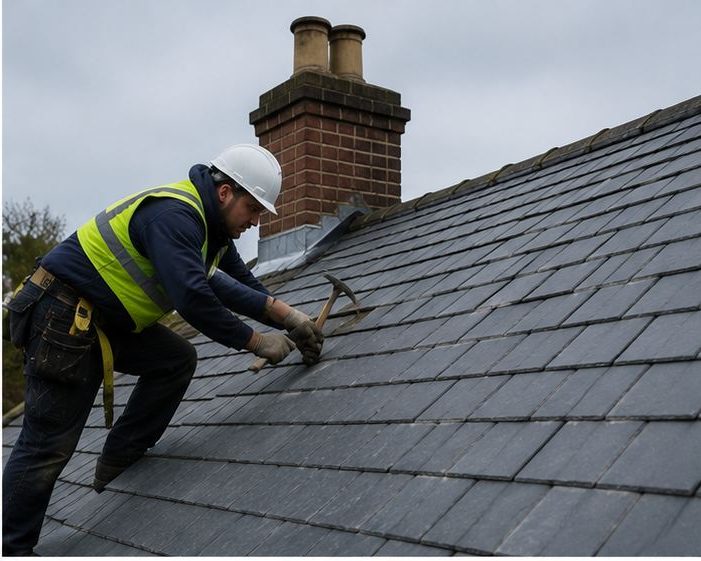
Slipped and cracked tiles or slates
Old fixings corrode and coverings shift with frost, wind and heavy rain. A few displaced pieces are a simple repair, but they are also the way water first gets under the covering. We replace what is broken and check the felt beneath, because the visible damage is often only part of what the roof has suffered. Photographs of the damage help you see exactly what has gone wrong.
Worn flashings and valleys
Lead flashings seal the roof where it meets a chimney, a party wall or a taller building. Valleys carry large volumes of water between two slopes. Both are common leak sources on terraces because of how many junctions there are, and both need to be checked from close up, not from the street. A dark streak on a wall near a chimney often points to a flashing failure.
- Lead pulling away from the wall or chimney
- Cracked or tired valley linings
- Mortar fillets that have fallen out
- Joins at the party wall that have opened up
Rear lean-tos, bay tops and small flat roofs
Extensions added over time have their own problems. Flat sections pond, split and blister, and upstands where they meet the main wall let water behind. Bay windows have small roofs with lead or flat coverings that are rarely looked at until a ceiling stains. These small areas cause a disproportionate number of leaks. If the flat part is the leaking part, repair or replacement depends on the deck beneath.
Ridge and hip bedding
Mortar along the ridge and hips cracks and falls away with time, loosening the capping tiles. It is easy to miss from the street. When it goes, rain and wind get under the roof's highest point. Re-bedding and re-pointing, or a dry-fixed alternative, is a straightforward job done well before the damage spreads. The mortar can be replaced, or a dry-fixed ridge system used where it suits the roof.
Gutters, fascias and the roof edge
Blocked gutters overflow, leaking joints wet the fascia and rotten boards stop holding the gutter. Water then gets into the eaves. It is the most common slow problem we see, and it often goes unnoticed until paint peels or a downpipe comes away. Checks from the ground often show the first signs. If you see a gutter dripping at a joint, note where, because it helps us find the cause.
Frequently Asked Questions
Which problem is the most urgent?
Anything that lets water in: an active leak, missing tiles or open flashings. Gutters hanging loose are also worth quick attention. Cosmetic issues and early moss can usually wait. We tell you what is urgent and what is not.
Why do so many leaks come from junctions?
Junctions have more joins and movement. Different materials expand at different rates, and sealing details wear. Water finds the smallest opening. A flat expanse of tiles is more forgiving than a chimney, valley or abutment.
Can I spot these problems myself?
From the ground you can see sagging gutters, slipped tiles, mortar on the path and stained ceilings. Please stay off the roof. Take photographs and note when problems appear, and we will do the close inspection.
Talk to our team about general roofing services in Easton
Every roof is different — the fastest way to get an accurate answer is a quick chat with our team.